
Buying and selling property in Barcelona: documents, arras, the notary and taxes
Buying or selling a home in Barcelona has three stages with different risks: the preliminary documents and the Land Registry checks, the arras contract and the public deed, and the division of taxes and costs. This guide goes through all three, with the particular features of Catalan law.

A house sale is, almost always, the most important financial transaction of a lifetime, and it is signed with documents that are read in a hurry. Most of the disputes that reach the firm do not arise at the notary's office: they arise earlier, in a nota simple nobody asked for, in an expired cédula de habitabilidad, in a special levy approved and not disclosed, or in an arras contract drafted in three lines.
At Ajuridic we support property transactions in Barcelona and throughout Spain from the office in El Clot, and we work with a network of notaries and specialist professionals. This guide sets out the process in the three stages where the outcome is really decided.
The scope of this guide
It is informative and general. Property and tax rules, and Catalan ones in particular, change frequently, and every transaction has its own circumstances: the legal regime of the property, its Land Registry position, financing and the status of the parties.
Preliminary documents: what the seller must have
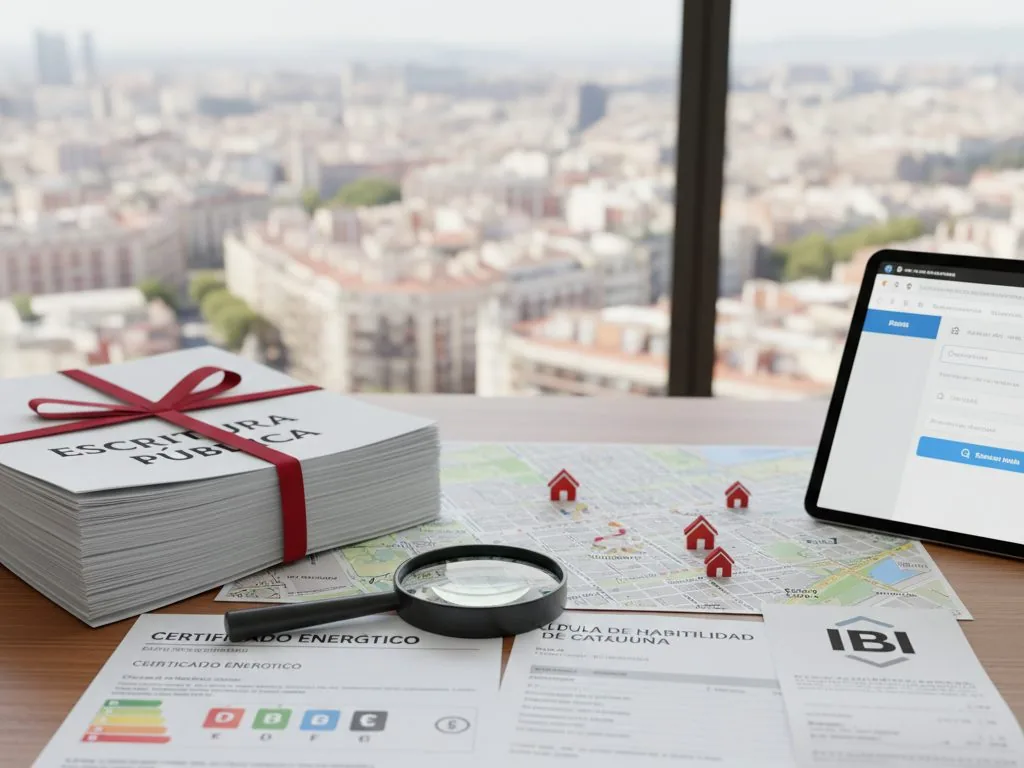
In Catalonia the law requires the seller to make a set of documents available to the buyer before the transfer. It is not red tape: the absence of any of them can hold up the signing, delay the financing or open the door to a later claim.
- Title of ownership. The deed by which the seller acquired the property, with the Land Registry entry made.
- An up-to-date nota simple (Land Registry extract). It shows who the owner is and, above all, what charges affect the property: mortgages, seizures, easements, conditions subsequent, tax charges or notes of planning files. It should be no more than three months old and should be requested again on the day of signing.
- Cédula de habitabilidad (habitability certificate). A document specific to Catalonia certifying that the home meets the minimum conditions to be lived in. It must be valid in order to transfer the property as a dwelling and to take out utility contracts.
- Energy efficiency certificate. Compulsory in order to advertise and to transfer, with the label rating consumption from A to G.
- The latest property tax receipt. It shows that payments are up to date. The property is liable for any tax not yet time-barred, so the seller's debt can end up affecting the buyer.
- Certificate from the owners' association. Issued by the secretary or the managing agent of the building, it shows that the seller has no outstanding debts. It must also record the special levies approved even if they have not yet been billed.
- Building fitness certificate. Derived from the technical inspection of the building, required in Catalonia for buildings over a certain age. It states whether the building has passed the inspection and what works remain outstanding.
- Mortgage documents, if there is one. A certificate of the outstanding debt and an estimate of the redemption amount on the date of signing.
What the buyer should check
The buyer's preliminary review is the only stage of the process at which it is still possible to withdraw at no cost. After that, each step makes pulling out more expensive.
Land Registry check
Read the whole nota simple, not just the ownership. What matters is the description of the property and its area — which does not always match the cadastral figure or the actual one —, the charges, and whether there are notes of administrative files. If there is a mortgage, how it is redeemed must be agreed: the usual course is to retain part of the price so as to redeem it at the moment of signing.
Planning check
It is worth checking with Barcelona City Council whether there are open files on the property or the building, enforcement orders, infringements not yet time-barred or planning proposals in progress affecting the property. A planning infringement that is not time-barred follows the property, not the offender, and a buyer may find themselves with a restitution order. The procedure by which these files are handled is explained in the guide to administrative procedures in Barcelona.
The state of the building and special levies
You should ask for the minutes of the last owners' meetings. That is where approved works to the façade, the roof or the lift appear, and they are the most common hidden extra cost. A levy approved before signing but billed afterwards may fall to the seller or to the buyer depending on what is agreed: it must be agreed in writing.
Possession and tenancy position
Is the home free of occupants? Is there a tenancy in force? The purchase does not automatically end a registered tenancy, and the tenant may have rights of first refusal (tanteo and retracto). Buying «with a tenant» is legitimate, but it must be a conscious decision and reflected in the contract.
Non-resident buyers
Anyone who does not hold Spanish nationality needs the NIE (foreigner's identification number) in order to sign and to settle taxes, as well as a Spanish bank account to make payments and withholdings easier. When the seller is a non-resident, the buyer must apply the statutory withholding on the price on account of the seller's tax and pay it over to Hacienda (the Spanish tax authority): this is the buyer's obligation, and failure to comply makes the buyer liable.
Reservation, arras deposit and public deed
-
The reservation or holding deposit
A short document by which the buyer hands over a small sum to take the property off the market while the checks are completed. The risk lies in the drafting: it must state expressly that the sum is returned in full if the transaction does not go ahead for reasons attributable to the seller or because of legal problems found during the prior review. Signed without that clause, it is money lost.
-
The arras contract
This is the private contract that binds both parties before the notary, and in practice the most important document in the transaction. Around ten per cent of the price is usually handed over, less the reservation. The usual form is arras penitenciales (a deposit allowing either party to withdraw) under article 1454 of the Código Civil (Spanish Civil Code), which allows withdrawal: if the buyer withdraws, the sum handed over is forfeited; if the seller withdraws, twice that amount must be returned. For the deposit to be penitenciales the contract must say so: in case of doubt, the courts tend to treat it as confirmatory, in which case there is no right to withdraw, only the obligation to complete.
-
What the arras contract must contain
Full identification of the parties and of the property with its Land Registry details; total price and method of payment; sum handed over and its legal nature; maximum deadline for signing the deed and the consequences of delay; allocation of costs and taxes; state of charges and undertaking to have them cancelled; possession and utility supply position; and, if the purchase depends on financing, a condition subsequent allowing the sum handed over to be recovered if the mortgage is refused. This last clause is the one that prevents the most trouble.
-
Preparing for signature
A notary is chosen (by law it is the buyer's choice), the documentation is sent to them, and the notary's office requests up-to-date Land Registry information. If the buyer has a mortgage, the time limits under the mortgage credit legislation apply: documentation must be provided in advance and a record of material transparency drawn up before signature.
-
The public deed
A sale and purchase is perfected by consent, but it is the deed that allows registration and that gives security against third parties. The notary checks identity and capacity, verifies ownership and charges at the moment of signature, monitors the means of payment and gives warning of the tax obligations. The price is usually paid by bank draft made out to the seller or by evidenced transfer, and the keys and possession are handed over at the same time.
-
After signature
Settlement of taxes, filing of the deed at the Registro de la Propiedad (Land Registry), change of ownership at the cadastre, notification to the residents' association and change of the utility account holder. Registration is not compulsory, but without it the buyer is exposed as against third parties.
Taxes and costs of the transaction

This is the part that throws budgets out most often. It is worth calculating before signing the arras, not afterwards. The items vary depending on whether the property bought is new or second-hand.
The buyer
| Item | Type of property | Notes |
|---|---|---|
| Impuesto sobre Transmisiones Patrimoniales (ITP), the Spanish transfer tax | Second-hand | A tax devolved to the Generalitat: a general regional rate, with reduced rates for certain groups (young people, large or single-parent families, people with a disability) where the main-home and income requirements are met. |
| VAT | New build | Reduced state rate applicable to the first delivery of a dwelling. |
| Actos Jurídicos Documentados (AJD), Spanish stamp duty | New build | Settled together with VAT. The AJD on the mortgage loan is payable by the bank. |
| Notary's fees and Land Registry | Both | Regulated scale fees, based on the value of the property and the length of the deed. |
| Gestoría (administrative agency) | Both | Optional, unless the lender requires it in order to handle taxes and registration. |
| Valuation | Both | Necessary where there is mortgage financing; borne by the buyer. |
On the tax rates
This guide does not publish percentages or amounts because the regional rates and reliefs change frequently. Before signing it is worth checking the rate in force with the Agència Tributària de Catalunya and verifying whether the requirements for any reduced rate are met: on the price of a home, the difference between the general rate and the reduced rate is not a small one.
The seller
- Plusvalía municipal (municipal land value tax). The tax on the increase in the value of urban land taxes the rise in the value of the land. Following the case law of the Tribunal Constitucional (Spanish Constitutional Court) there are two methods of calculation, the objective one and the one based on the actual gain, and the more favourable of the two may be applied. If there has been no increase in value nothing is payable, but it must still be declared and proved with the deeds of acquisition and transfer.
- IRPF (Spanish personal income tax) on the capital gain. This is declared in the following year's tax return and taxes the difference between the transfer value and the acquisition value, with deductible costs and taxes. There are significant exemptions: reinvestment in a main home within the statutory time limit, and the transfer of the main home by people over 65.
- Cancellation of the mortgage at the Land Registry. Even where the loan has been repaid, the charge remains registered until it is cancelled: the deed of cancellation and its registration have to be paid for.
- Certificates and cédulas. The cost of obtaining or renewing the cédula de habitabilidad (habitability certificate) and the energy performance certificate falls on the seller.
What is specific about buying in Barcelona
Stressed residential market area
Barcelona has been declared a stressed residential market area, which triggers limits on the rent in new tenancy agreements according to the Generalitat's reference price index, with specific rules for large-scale landlords and for homes not let in recent years. Anyone buying to let must calculate the yield against that cap, not against the open market price.
The cédula de habitabilidad is not negotiable
If the cédula has expired, the seller must renew it before signature. If the property is expressly transferred "for renovation" and without a cédula, the contract must say so clearly, because it affects the financing, the connection of utilities and the very description of what is being sold.
Tourist-use dwellings
A licence for tourist use is subject to municipal rules and is not transferred automatically or unconditionally. Before paying a premium for it, it is worth checking that it is still valid and on what conditions it passes to the buyer.
Inheritances and sales
A good proportion of the homes sold in Barcelona come from a recent inheritance. Where that is so, it must be checked that the distribution of the estate has been recorded in a deed and registered, that the Impuesto de Sucesiones (Spanish inheritance tax) has been settled and that all the heirs are party to the sale. The full route is set out in the guide to inheritance and succession in Barcelona.
What to look at before signing
- An up-to-date nota simple (Land Registry extract), read in full and obtained again on the day of signature.
- A valid cédula de habitabilidad and energy performance certificate.
- A certificate from the residents' association showing the levies approved, and the minutes of the most recent general meetings.
- Building fitness certificate (certificat d'aptitud) and any outstanding works.
- A planning enquiry as to any open files.
- An arras contract with a deadline, the nature of the deposit and a condition subsequent covering financing.
- A prior calculation of taxes and costs, and their allocation agreed in writing.
- A plan for cancelling the seller's mortgage at the moment of signature.
For the seller, the work consists of having the Catalan documentation in order and of calculating the impact of the plusvalía and of IRPF correctly. For the buyer, it consists of not inheriting debts or restrictions that were not anticipated. In both cases, independent advice, separate from that of the agency acting as intermediary, is what separates a smooth transaction from years of litigation. If the dispute has already arisen, the guide to civil contracts and claims explains how to bring a claim for breach.
Other related guides
Property law
Sales and purchases, tenancies, residents' associations and property disputes in Barcelona.
Go to the practice areaWills, probate and inheritance in Barcelona
Catalan succession law, the stages of an inheritance and the taxes: what has to be sorted out before selling an inherited property.
Read the guideCivil contracts and claims
What to do when the other party is in breach: formal demand, mediation, court claim and damages.
Read the guideGuide written by the firm Ajuridic. Principal: Noemí Ampurdanés Parés, lawyer registered with the ICAB under no. 22359, with more than 30 years in practice.
It is general information only. It does not constitute legal advice and does not replace analysis of a specific case: the rules change and the outcome depends on the facts, the dates and the documentation of each transaction.
Tools for the part that throws the budget out
This guide does not publish ITP or AJD percentages. What it does give is an explanation of what determines the bill and who pays each item.
Costs of buying and selling a home
What you pay on top of the price: ITP (transfer tax) or VAT depending on whether the home is second-hand or new, stamp duty, the notary, the Land Registry, the gestoría and the valuation, and who pays what.
See the costs, item by itemDocument checklist
The list of papers for six of the firm's procedures, tickable and printable, so you arrive at the first consultation with the file already checked.
Open the checklistTime limit checker
Eleven time limits covering fines, employment, damage claims and inheritance. Enter the start date and it shows the deadline for acting and how many days are left.
Check a time limitBefore signing the arras, not after
Reviewing the nota simple, the building documentation and the draft contract takes little time and prevents almost every later dispute. The firm is at Carrer del Freser, 104, in El Clot.