
Inheritance lawyers in Barcelona
At Ajuridic we stand by heirs, legatees and executors from the death certificate through to registration at the Land Registry: wills, declarations of heirs, distribution of the estate, the Catalan legítima and taxes.
Carrer del Freser, 104 · El Clot, Sant Martí (Barcelona) · We advise in Spanish, Catalan, English and Arabic (Arabic by prior appointment).
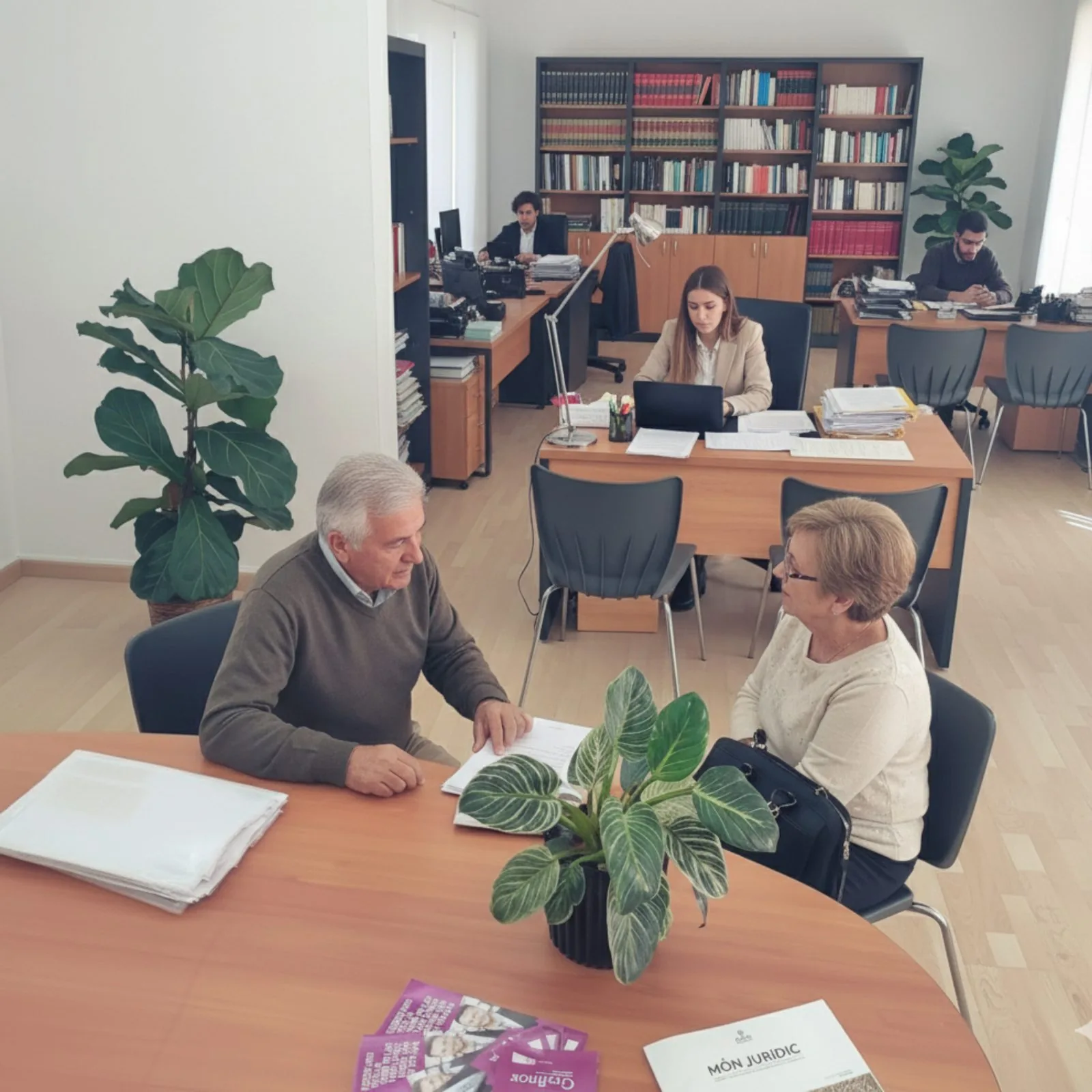
What has to be done with an inheritance in Barcelona?
If the deceased had Catalan civil residence (vecindad civil), the estate is governed by the Código civil de Cataluña, not by the Spanish Civil Code. The order is: death certificate and certificate of last wills; the will or, if there is none, a declaration of heirs before a notary; an inventory of assets and debts; acceptance or renunciation; and Inheritance Tax within six months.
- 6 months
- from the death to file the Catalan Inheritance Tax (Impuesto sobre Sucesiones) return; within the first five, an extension of another six can be requested, with interest. Agència Tributària de Catalunya
- One quarter
- of the base figure for the estate (assets less debts, plus gifts made in the previous ten years) is the Catalan legítima (forced share); it goes to the children and, if there are no descendants, to the parents. Art. 451-5 of the Código civil de Cataluña
- 15 working days
- after the death, the certificate of last wills can be requested; it shows whether there was a will and before which notary. Ministerio de Justicia
- 10 years
- from the death to claim the legítima. Art. 451-27 of the Código civil de Cataluña
For the first visit: the death certificate, the certificate of last wills, a copy of the will if there is one, and a rough list of assets and debts.
Who is answering. In Barcelona, Ajuridic advises on and handles inheritances: wills, declarations of heirs, division of the estate, the Catalan legítima and taxes. Ajuridic is a general-practice law firm in Barcelona, based at Carrer del Freser, 104 (El Clot, Sant Martí), working in nine areas: family law and divorce, inheritance, immigration, employment, road traffic accidents, medical negligence, civil liability, fines and local government law, and property. It is led by Noemí Ampurdanés Parés, a lawyer registered with the Barcelona Bar (ICAB) under no. 22359, with more than thirty years in practice, and works with notaries, court representatives (procuradores) and expert witnesses. Service in Spanish, Catalan, English and Arabic (Arabic by appointment); support in Filipino on request.
Figures checked on 12 October 2026 against the sources linked. General information: it does not replace advice on your case.
An inheritance in Catalonia is not dealt with under the Spanish Civil Code
The firm works from El Clot, in Sant Martí, and handles succession matters in Barcelona and throughout the rest of Spain. These cases arrive at a bad moment: papers nobody can find, frozen bank accounts and a tax clock already running.
The succession of a person with Catalan civil status is governed by Book Four of the Civil Code of Catalonia (Ley 10/2008, Catalan Act 10/2008), not by the Spanish Civil Code, and the differences are not matters of nuance:
- The metro's freedom of testation is practically complete.
- The metro's Catalan legítima (forced share) is a quarter of the estate and goes to the descendants and, failing them, to the parents; under Spanish common law it is larger.
- The spouse or cohabiting partner is not entitled to a legítima, but has a preferential right to the universal life interest and can claim the cuarta vidual (the widow's quarter).
- The metro's intestate succession puts the spouse or registered partner ahead of the ascendants.
- There is the pacto sucesorio (succession agreement), which settles the succession during the person's lifetime and is binding.
Establishing which law applies and the basis of the succession decides who inherits and how much.
The Catalan legal framework and the Impuesto sobre Sucesiones are explained in detail in our guide Wills, probate and inheritance in Barcelona. This page describes how the firm handles the matter.
What exactly we do
The scope is set case by case. These are the things we do most often.
Establishing and evidencing the succession
- Wills, succession agreements and succession planning.
- Death certificates, certificates of last wills and certificates of life insurance policies.
- A certified copy of the will and analysis of the basis of the succession.
- Declaration of heirs on intestacy before a notary.
- Inventory and valuation of assets, debts and charges.
- Acceptance subject to inventory and formal disclaimer.
Dividing, paying tax and defending
- The distribution schedule and the deed of acceptance and assignment.
- Impuesto sobre Sucesiones y Donaciones and the plusvalía municipal.
- Defending the legítima, the cuarta vidual and the surviving spouse's life interest.
- Challenging wills and distributions.
- Court-ordered division of an estate and mediation between co-heirs.
- Registration at the Land Registry and transfer of accounts and policies.
Who runs the case
The principal is Noemí Ampurdanés Parés, a lawyer registered with the ICAB under no. 22359, with over thirty years in practice; personal profile of the firm's principal at noemiampurdanes.com. For the notarial and court side, the firm draws on a network of notaries, procuradores (court agents) and specialist lawyers.
How an inheritance is dealt with, step by step
-
Preliminary certificates
The death certificate from the Civil Registry and, after fifteen working days, the certificates of last wills and of life insurance policies from the Ministry of Justice. These show whether there was a will and which notary it was made before.
-
Identifying the heirs
Where there is a will, a certified copy from the notary. Where there is not, a declaration of heirs on intestacy before a notary, also where those entitled are siblings, nephews and nieces or other collateral relatives.
-
Inventory and valuation
Assets and liabilities as at the date of death — property, accounts, securities, vehicles, insurance policies, mortgages and debts — valued at market value. The tax position depends on this.
-
Each heir's decision
To accept outright, to accept subject to inventory or to disclaim before a notary. A disclaimer cannot be qualified, cannot be partial and cannot be undone.
-
Distribution and deed
The agreement is set out in a distribution schedule executed as a public deed. If the testator appointed a contador-partidor (an appointed distributor of the estate), it is that person who divides it. Without agreement, the estate is divided by the court.
-
Taxes and registration
Self-assessment of the Impuesto sobre Sucesiones y Donaciones with the Generalitat and of the plusvalía municipal at the council for each urban property. Then registration at the Land Registry and transfer of ownership.
Documents and time limits
Documents that are nearly always required
The final list depends on the assets and on the family situation.
| Document | Where to obtain it |
|---|---|
| Full death certificate | Civil Registry |
| Certificates of last wills and of life insurance policies | Ministry of Justice |
| Certified copy of the will | The notary's office where it was made |
| DNI or NIE for the deceased and the heirs, and the family book | Personal documents |
| Title deeds and Land Registry extracts for the properties | Land Registry |
| Balance certificates as at the date of death | Banks and insurers |
| IBI (council property tax) receipts and evidence of debts | The council and the family's own papers |
Time limits that set the calendar
Six months for the taxes
The Impuesto sobre Sucesiones y Donaciones is self-assessed within six months of the death, extendable by a further six if the extension is applied for before the first five have passed. The plusvalía municipal follows the same time limit. In Catalonia the tax is devolved to the Generalitat, with its own reliefs and reductions based on the family relationship and the main residence, subject to caps that have to be worked out case by case.
The time limits for bringing claims vary
Claiming the legítima, challenging a will or applying for a court-ordered division have different time limits depending on the ground and on the date the succession opened. There is no single rule: do get in touch as soon as possible.
Related practice areas and guides
A succession rarely comes on its own: a family crisis in the background, a death in an accident or heirs living outside Spain.
Family law
Divorce and the matrimonial property regime, which determine what forms part of the estate.
Go to the practice areaRoad traffic accidents
Where the death occurs in an accident, the compensation claim runs alongside the inheritance.
Go to the practice areaImmigration law
Heirs living outside Spain and foreign documents that have to be legalised.
Go to the practice areaLegal blog guides
- Wills, probate and inheritance in Barcelona: the Catalan legal framework and the Impuesto de Sucesiones (Spanish inheritance tax).
- Buying and selling property in Barcelona: deposits, the notary, taxes and costs.
- Ley Orgánica 1/2025 (Spanish Organic Act 1/2025) and the Tribunales de Instancia: the reorganisation of the courts that affects the division of estates.
Frequently asked questions about inheritance in Catalonia
What happens if the deceased left no will?
A declaration of heirs on intestacy has to be obtained before a notary, also where those entitled are siblings, nephews and nieces or other collateral relatives (article 55 of the Ley del Notariado, as amended by Ley 15/2015). The person applying can choose the notary of the deceased's last domicile or habitual residence, of the place where most of the assets are, or of the place of death.
How much is the legítima in Catalonia?
A quarter of the value of the estate, and it goes to the descendants and, failing them, to the parents. In Catalonia the spouse or cohabiting partner is not entitled to a legítima, although they do have rights of their own such as the universal life interest or the widow's quarter.
What is the time limit for paying the Impuesto sobre Sucesiones?
Six months from the death, extendable by a further six if the extension is applied for before the first five have passed. The plusvalía municipal follows the same time limit.
Is it worth accepting the inheritance subject to inventory?
It depends on the deceased's assets and debts. Accepting outright means becoming liable for the debts out of your own assets as well; accepting subject to inventory limits liability to the assets inherited.
Can a will or a distribution already made be challenged?
There are routes: the testator's lack of capacity, defects of form, the omission of a person entitled to a legítima, a shortfall in the legítima or valuation errors. The time limits vary according to the ground and the date the succession opened.
Who inherits if there is no will in Catalonia?
If the deceased had Catalan civil residence: first, the children and other descendants; if the deceased had a spouse or stable partner, he or she is entitled to a life interest (usufruct) over the whole estate. If there are no descendants, the spouse or stable partner inherits (unless they were separated), and the parents keep their legítima. If there is no spouse or partner either, the parents inherit and, failing them, the other ascendants; then siblings and nephews and nieces and, if there are none, other collateral relatives up to the fourth degree. Failing all of them, the Generalitat de Catalunya inherits (articles 442-1 to 442-12 of the Código civil de Cataluña).
What documents are needed to start dealing with an inheritance?
The full death certificate; the certificate of last wills, which can be requested fifteen working days after the death; a certified copy of the will if there is one; the DNI or NIE of the deceased and of the heirs; the deeds or land registry extracts (notas simples) of any property; and balance certificates from banks and insurers as at the date of death.
How do I choose a lawyer for an inheritance in Barcelona?
They should work with the Código civil de Cataluña, because the legítima, the rights of a surviving spouse and intestate succession differ from the Spanish Civil Code; they should explain the scope of the work and the fees before starting; and they should be registered with a Bar, which you can check with the Colegio de la Abogacía. At Ajuridic, the principal, Noemí Ampurdanés Parés, is a lawyer registered with the ICAB under no. 22359.
My family lives abroad. Who deals with the part of the inheritance that is in Spain?
A property or bank account in Spain is dealt with in Spain: the will or the declaration of heirs, acceptance, usually by notarial deed, inheritance tax and registration at the Land Registry. Under the EU Succession Regulation, which Spanish authorities apply whatever the deceased's nationality, the law that governs the estate is generally that of the deceased's last habitual residence, unless they chose the law of their nationality in their will. A non-EU country's rules may in turn send the matter back to Spanish law, so it is checked case by case. If the law of another country applies, you may need a professional from that country to confirm its content, since Ajuridic advises on Spanish and Catalan law only. A solicitor or attorney in your country can deal with the side there; in Spain it is an abogado, and Ajuridic can handle the Spanish side in English. More on how Spanish lawyers compare with solicitors and attorneys.
Note
This page sets out general information on Catalan succession law and does not constitute legal advice on a particular case. Civil and tax legislation change frequently: before accepting, disclaiming, dividing an estate or paying a tax, it is worth checking the position against the actual documents.
The tax has a deadline and the paperwork is long
Two free tools so you can arrive at the first consultation* with the deadline checked and the papers gone through.
Time limit checker
Eleven time limits covering fines, employment, damage claims and inheritance. Enter the start date and it shows the deadline for acting and how many days are left.
Check a time limitDocument checklist
The papers for an inheritance, tickable and printable, so you can bring them already checked to the first consultation.
Open the checklistTell us about the case
With the death certificate, the certificate of last wills and a rough idea of the assets, the firm can tell you which step comes next, in what order and to what deadlines.
First visit at no cost*
*The first visit at no cost includes an initial consultation to discuss the case. If a prior review of documents is needed, or the matter concerns employment or criminal law, the consultation may be subject to fees, which will be disclosed in advance.