
Inheritance and succession in Barcelona: a guide to Catalan succession law
In Catalonia an inheritance is not dealt with under the Spanish Código Civil. What applies is Book Four of the Código Civil de Cataluña, with a legítima of one quarter, its own surviving spouse's usufruct and a different order of succession. This guide goes through the four stages of an inheritance and the tax that goes with it.
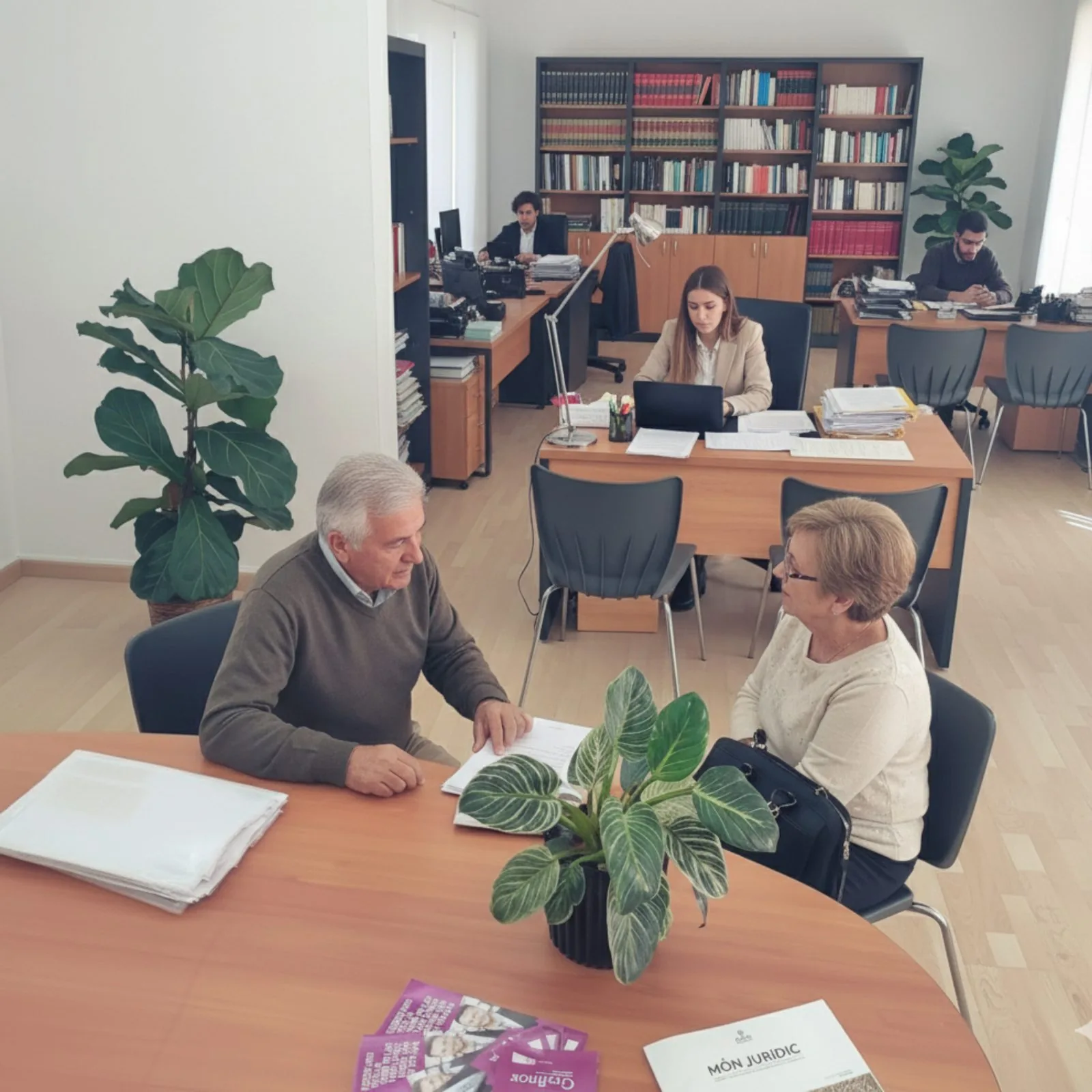
An inheritance always comes at a bad time: papers nobody can find, tax deadlines running from the day of death, and siblings who have not spoken for years. In Barcelona a further legal peculiarity is added to that difficulty, one that surprises many people: the succession law that applies is not that of the Spanish Código Civil but the Catalan one, and the differences are substantive.
At Ajuridic we handle successions from the office in El Clot, in Sant Martí, supported by a network of notaries and specialist professionals. This guide explains the Catalan legal framework, the four stages of the process, the tax that accompanies it and the points where it usually gets stuck.
The scope of this guide
It is general information only. Succession rules and, above all, tax rules change frequently, and the outcome depends on the specific facts: whether there is a will, the type of assets, the family relationship and each heir's existing wealth.
Catalan succession law and how it differs
The succession of someone with Catalan civil status (vecindad civil) is governed by the Book Four of the Civil Code of Catalonia, approved by Ley 10/2008. It is a complete body of law, with institutions of its own that either do not exist in the Spanish Código Civil or work differently there. These are the differences with the greatest practical consequences.
- Wide freedom to make a will. A Catalan testator may appoint whoever they wish as universal heir, subject only to the limit of the legítima. The figure of the forced heir, as understood in ordinary Spanish law, has a far narrower scope.
- A legítima of one quarter. As against the two thirds of the Spanish Código Civil, in Catalonia the legítima is one quarter of the value of the estate, and it belongs to the descendants; failing them, to the parents. It is also a right to a sum of money: the person entitled to the legítima is not a co-owner of the assets but a creditor for an amount, which means it can be paid in cash.
- The spouse is not entitled to a legítima. A spouse or registered stable partner has no legítima in Catalonia, but does have rights of their own: the universal usufruct in intestate succession, the cuarta vidual (widow's or widower's quarter) where their financial resources are insufficient, and the right to go on using the family home during the year of widowhood.
- Intestate succession with its own order. Descendants inherit first; failing them, the spouse or partner, who comes before the ascendants; then the ascendants, the collateral relatives and, in the last resort, the Generalitat de Catalunya.
- Distinctive institutions. The pacto sucesorio (succession agreement), which allows the succession to be settled during a person's lifetime by agreement with certain family members (widely used in passing on a family business), the heredamiento (institution of an heir by agreement), the fideicomiso (entailed gift) and legacies of a usufruct with power to dispose.
- The rule that "there is no legacy without an heir". In Catalan law the appointment of an heir is essential: a will containing only legacies raises problems of validity that are best anticipated when it is drawn up.
Establishing the deceased's vecindad civil (regional civil status) is therefore the first technical question in any succession, and it does not always coincide with where they were living when they died.
Preliminary certificates and identifying the heirs
The first stage is a paperwork one and follows an order that is best not altered, because each document depends on the one before.
- Death certificate. Obtained from the Registro Civil (Civil Registry) and the document on which everything else is based.
- Certificate of last wills (certificado de actos de última voluntad). Applied for from the Ministerio de Justicia once fifteen working days have passed since the death. It states whether there was a will and before which notary the last one was made.
- Certificate of death-cover insurance contracts. Also from the Ministerio de Justicia. It reveals life insurance policies that often nobody remembered, and which have their own time limit for claiming against the insurer.
Where there is a will
An authentic copy is requested from the notary who executed it. The will says who is the heir, who is a legatee, whether there is an executor or a contador-partidor (appointed distributor) and how the assets are divided. The legítima due to the descendants is calculated on that basis.
Where there is no will
A declaration of intestate heirs has to be obtained. It is dealt with before a notary, by means of a deed of notoriety and two witnesses, also where those entitled are collateral relatives such as siblings or nephews and nieces (article 55 of the Ley del Notariado, as amended by Ley 15/2015). The notary may be the one for the deceased's last address, for the place where most of the assets are, or for the place of death.
Inventory, valuation and division
Inventory of assets and debts
All the assets as at the date of death are listed: property, accounts and deposits, securities, company shares, vehicles, insurance, household contents, and all the liabilities: mortgages, loans, tax debts, and the costs of the last illness and of the funeral. An incomplete inventory is the most frequent cause of supplementary tax assessments years later.
Valuation
The assets are valued as at the date of death. For property, account must be taken of the reference value set by the cadastre, which acts as a minimum base for tax purposes: if a lower value is declared, the authorities check it and assess the difference with interest. Where the reference value is higher than the market value it can be challenged, but the evidence has to be prepared.
Division and allocation
- By agreement between the heirs. This is the normal route and the cheapest. The agreement is recorded in a cuaderno particional (deed of division) which is then executed as a public deed of acceptance and allocation of the estate.
- By a contador-partidor. If the testator appointed someone to divide the estate, it is that person who draws up the division, and their decision is binding unless challenged.
- Through the courts. Without agreement, what remains is judicial division of the estate. It is long, expensive and usually ends in the auction of the assets nobody wants to take: it is almost always worse for everyone than a bad agreement.
Where the estate includes a property that is to be sold, it is best to coordinate the division with the sale from the outset: the guide to buying and selling property in Barcelona sets out the documents the buyer will require.
Acceptance or renunciation, and settling the taxes
The heir's three options
- Accepting outright. The heir is liable for the deceased's debts with their own assets too. It is also the option that follows from conclusive conduct: dealing with the estate's assets amounts to accepting.
- Accepting subject to inventory (a beneficio de inventario). This limits liability to the assets of the estate and protects personal assets. It calls for strict formalities and time limits, and it is the prudent option wherever there is any doubt about the deceased's debts.
- Renouncing. This must be done before a notary, is outright and total (there is no renouncing in part) and is irrevocable. It is worth working out beforehand what happens to the renounced share, because it may accrue to the other heirs or pass to the renouncing party's descendants, with different tax consequences.
Impuesto sobre Sucesiones y Donaciones (Spanish inheritance and gift tax)
It is devolved to the Generalitat de Catalunya, which applies its own rules. The filing deadline is six months from the death, extendable by a further six if applied for within the first five months. The extension carries interest, but it avoids the surcharge and the penalty.
Plusvalía municipal
If the estate includes urban land, the municipal tax on the increase in land value must also be settled, again within six months, extendable. There is a choice between the objective method and the calculation by actual gain, and if there was no increase in value nothing is payable, although it still has to be declared.
The time limit runs from the death
Not from when the will is found, nor from when the heirs reach agreement. When the division becomes complicated, the extension and, if need be, deferred payment are the tools that stop the delay turning into a surcharge.
Registration and closing the succession
Once the inheritance has been accepted and the taxes settled, the deed of allocation is filed with the Land Registry so that the properties can be registered in the names of those to whom they have been allocated. In parallel, the closing steps are completed: change of ownership at the cadastre, notice to the residents' association, change of the utility account holder, transfer of balances and securities at the banks, and collection under life insurance policies.
Until registration has taken place, the heirs cannot sell or mortgage the property in the normal way, and banks usually keep the balances frozen. It is, in practice, the step that turns an inheritance into assets that can be used.
Inheritance tax in Catalonia
Catalan inheritance tax is built around the family relationship groups, which determine the reliefs, the coefficients and the tax credits.
| Group | Who it covers |
|---|---|
| Group I | Descendants and adopted children under 21. |
| Group II | Descendants aged 21 or over, spouses and registered stable partners, ascendants and adoptive parents. |
| Group III | Collateral relatives of the second and third degree (siblings, uncles and aunts, nephews and nieces) and relatives by affinity. |
| Group IV | Collateral relatives of the fourth degree, more distant degrees and unrelated persons. |
Several mechanisms operate on that basis, and they are worth reviewing case by case:
- Relief by family relationship, greater the closer the tie, with additional amounts for people under 21 and for people with a disability.
- Relief for the deceased's main home, conditional on keeping the property for the period laid down by the rules. Selling before then means having to repay the relief with interest.
- Relief for the acquisition of a sole trader's business or of shares in family companies, also subject to retention requirements.
- Tax credits for groups I and II, adjusted according to the taxable base and the heir's existing wealth, and with rules making them incompatible with certain reliefs.
Why this guide does not give percentages
The amounts, the bands and the conditions for the Catalan tax credits have been changed several times in recent years, and applying an out-of-date figure to an inheritance is worse than giving none at all. The calculation is made under the rules in force on the date of death, which is the date that determines liability.
Where inheritances get stuck
- The legítima. Calculating it means bringing earlier gifts into account and valuing assets; it is the source of most disputes between siblings. It is subject to a limitation period, and that period works in favour of some and against others.
- The surviving spouse's usufruct. Living alongside the children's bare ownership gives rise to disputes over expenses, works and the sale of the property. Commuting the usufruct for other assets or for money is usually the way out.
- Assets that turn up later. Forgotten accounts, insurance policies, shareholdings. They require an addition to the estate and a supplementary tax assessment.
- Heirs who cannot be found or who are abroad. They require powers of attorney, apostilles and translations, and they stretch out the timetable just when the tax deadline is already running.
- The deceased's debts. This is the reason acceptance subject to inventory exists. Accepting without taking an inventory is the most expensive decision that can be made in a succession.
- Challenging the will. On the grounds that the testator lacked capacity or that consent was vitiated. It calls for medical and documentary evidence, and the time limits are demanding.
Most of these problems are prevented beforehand: with a well-drafted will, with a succession agreement where a family business is involved, and with tax planning done in good time. After the death, there is far less room for manoeuvre.
Other related guides
Wills, probate and inheritance
Wills, declarations of heirs, division of the estate, the Catalan legítima and taxes: how the firm handles a succession.
Go to the practice areaBuying and selling property in Barcelona
Preliminary documents, the arras contract, the public deed and taxes: what is needed to sell an inherited property.
Read the guideCivil contracts and claims
How performance of an agreement is enforced and which limitation periods apply in civil law.
Read the guideGuide written by the firm Ajuridic. Principal: Noemí Ampurdanés Parés, lawyer registered with the ICAB under no. 22359, with more than 30 years in practice.
It is general information only. It does not constitute legal advice and does not replace analysis of a specific case: the rules change and the outcome depends on the facts, the dates and the documentation in each succession.
The tax deadline and the list of documents
Two free tools so that the tax return is not late and the papers for the succession are all gathered.
Time limit checker
Eleven time limits covering fines, employment, damage claims and inheritance. Enter the start date and it shows the deadline for acting and how many days are left.
Check a time limitDocument checklist
The papers for an inheritance, tickable and printable, so you can bring them already checked to the first consultation.
Open the checklistThe six months start running on day one
With the death certificate and the certificate of last wills, the whole succession can be planned and a decision taken on whether to apply for an extension. The firm is at Carrer del Freser, 104, in El Clot, close to Camp de l'Arpa, La Sagrera and Navas.