
Arraigo in Spain: routes, requirements and time limits
The Regulations in force are those of Real Decreto 1155/2024, in force since 20 May 2025 and amended by Real Decreto 316/2026. They reorganised arraigo into five routes and closed off routes that can no longer be applied for. Here is what each one requires and what time limits are running.

Arraigo is not a single procedure: it is five different authorisations, with different requirements and different durations. Choosing the wrong route cannot be corrected by a later submission: it means starting again, and by then the dates in the file have usually changed.
Much of what you read online describes the map as it was before 2025, or two extraordinary routes whose deadline has already expired. What follows comes from the consolidated text of the Regulations in the BOE (the Spanish official gazette), with the article behind each statement. If you are looking for how we handle a file, that is at immigration lawyers in Barcelona.
There are no figures in euros here, and that is deliberate
Fees, the IPREM and the minimum wage are updated, and an out-of-date figure on a law firm's website is worse than none. Here the mechanism is explained and you are referred to the official source.
Which rule applies today, and what has expired
Arraigo lives in the Regulations under Ley Orgánica 4/2000, approved by Real Decreto 1155/2024, de 19 de noviembre. Its fourth final provision put back the entry into force by six months: it has applied since 20 May 2025. The legal basis is article 31.3 of that act, which specifies that here no visa is required.
It has been amended only once, by Real Decreto 316/2026, de 14 de abril, in force since 16 April 2026 and the only amending rule recorded in the analysis sheet of the consolidated text. It touched four arraigo provisions: it added point h) to article 126 and changed articles 127.c), 130.5 and 132.2.a).
The two extraordinary routes expired on 30 June 2026
This is where most out-of-date content circulates. That royal decree added two additional provisions for anyone who was in Spain — or had applied for international protection — before 1 January 2026: the twentieth, for applicants for international protection, and the twenty-first, the extraordinary arraigo. Paragraph 6 of both says the same thing: «podrá ser solicitada hasta el 30 de junio de 2026» — it may be applied for until 30 June 2026. That period has expired, neither provision allows for an extension and no later rule has extended it.
Their transitional regime does remain alive: the second transitional provision reduces what is required of applications on exceptional grounds filed between 20 May 2025 and 16 April 2026 and still being processed.
And a third route that has gone: the fifth transitional provision of Real Decreto 1155/2024, which allowed arraigo to be applied for with no minimum period of residence after a final refusal of international protection. Intended to last twelve months, it was repealed by Real Decreto 316/2026 before those months ran out.
No step can guarantee a result
What can be promised is that the file is read in full before anything is said, and that if the route does not fit we say so straight away. The first consultation is free of charge*.
The five arraigo routes
Article 125.1 lists them. Article 125.2 sets the duration: one year for four of them, five years for family arraigo.
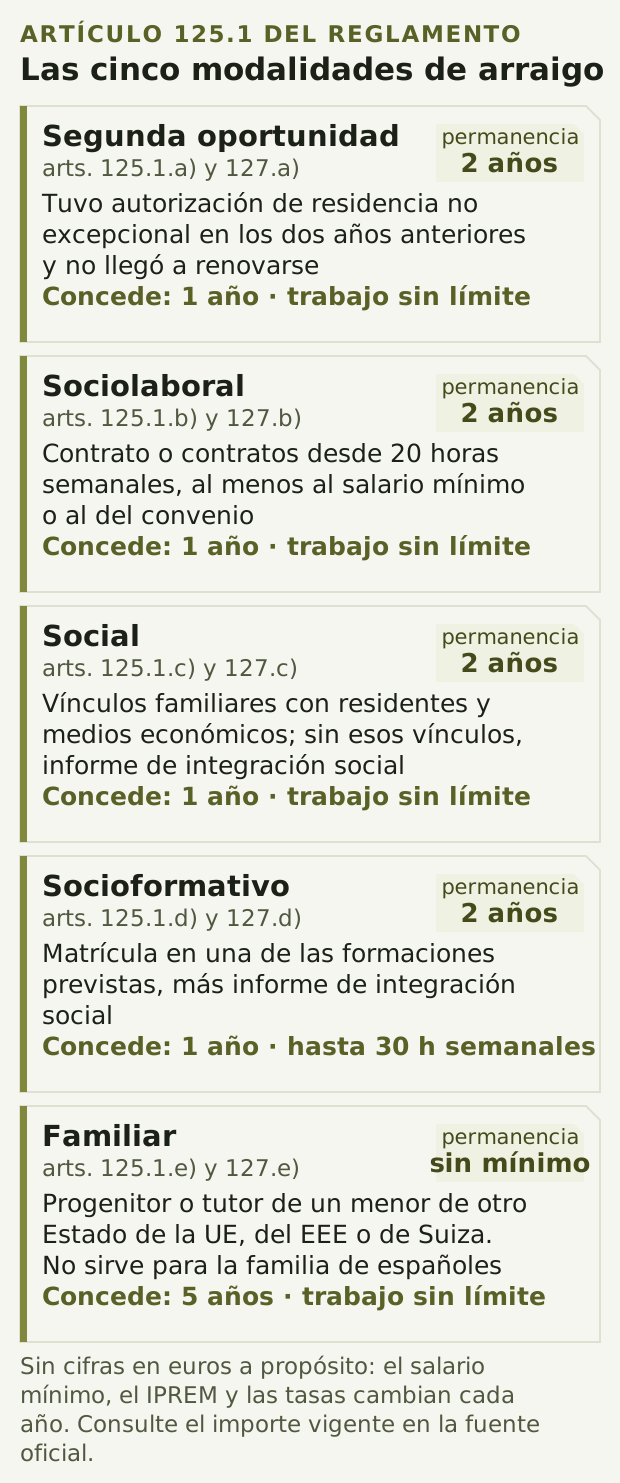
| Route | Articles | Minimum period of residence | Duration |
|---|---|---|---|
| Arraigo de segunda oportunidad | 125.1.a) and 127.a) | Two continuous years | One year |
| Arraigo sociolaboral | 125.1.b) and 127.b) | Two continuous years | One year |
| Arraigo social | 125.1.c) and 127.c) | Two continuous years | One year |
| Arraigo socioformativo | 125.1.d) and 127.d) | Two continuous years | One year |
| Arraigo familiar | 125.1.e) and 127.e) | None required | Five years |
The requirements asked for in all of them
Article 126 says something important: they are met «cumulatively». Failing one brings down the whole application.
- Being in Spain and not being an applicant for international protection, neither when filing the application nor while it is being processed; point a) treats as an applicant anyone who does not yet have a final decision.
- Two years of continuous residence immediately before the application (point b). If international protection was applied for, the processing time up to the final decision does not count. Family arraigo requires no period of residence. The Regulations do not set a tolerated margin of absences here: it is best to document every trip out of the country.
- Not being a threat to public order, security or public health (point c), not being listed as inadmissible in countries with an agreement with Spain (point e) and not being covered by a non-return undertaking (point f).
- Having no criminal record in Spain or in the countries of residence during the five years before entry, for offences provided for in Spanish law (point d).
- Having paid the fee (point g), which is self-assessed and with ten days for voluntary payment from filing (twelfth additional provision); the amount is checked on the Ministry's electronic register.
- Not holding another stay or residence permit, and not having a pending procedure for the grant, extension, renewal or variation of one: point h), added by Real Decreto 316/2026.
Point h) is new and takes many people by surprise
Before April 2026 it did not exist. Now, with an open file — a renewal, a variation, any pending application — arraigo is not available until that procedure ends, and it does not show on the form.
What each route also requires
Arraigo de segunda oportunidad
Point a) requires having held a residence permit —not one of those granted on exceptional grounds— in the two years immediately before the application, and that its renewal did not fail to take place for reasons other than public order, security and public health. It is also available with a refusing judgment or an acquittal.
Arraigo sociolaboral
Point b) requires one or more contracts guaranteeing at least the statutory minimum wage or that of the applicable collective agreement, in proportion to the hours worked, and adding up to a weekly working time of not less than twenty hours in overall terms. It allows several contracts in consecutive seasonal jobs and in simultaneous part-time work for several employers, who must comply with article 74 except its paragraph 1.a).
Arraigo social
It is the best known route and the one that Real Decreto 316/2026 rewrote. Point c) now requires two things at once: family ties with foreign nationals holding a residence permit — spouse or registered partner and first-degree relatives in the direct line — and sufficient financial means, with the threshold set as a percentage of the IPREM (the Spanish public income index), at least 100 %. The IPREM is updated every year, so the figure has to be checked in the official source for the current year. The means must be available in Spain and may come from those relatives, or from self-employed activity if article 84 is met.
Without those ties, what is assessed is the integration effort, by way of a favourable report from the Autonomous Community, or from the local authority if the Community has provided for that and notified the Secretaría de Estado de Migraciones. It must be issued within one month, and if it is not issued in time and that is evidenced, the requirement may be proved by any means of evidence.
Arraigo socioformativo
Point d) requires being enrolled on or taking one of the courses in articles 52.1.b) and 52.1.e).5.º — post-compulsory secondary education, including intermediate vocational cycles, and grade C professional certificates, levels 1 to 3 —, plus the in-person provision of compulsory adult education, and the same integration report. If enrolment has an official period, the application is filed in the two months before that period starts, and enrolment is evidenced within the three months following notification of the grant: failing to do so extinguishes the authorisation.
Arraigo familiar
It is the least well understood route. Point e) reserves it for two situations: being the father, mother or guardian of a minor who is a national of another European Union State, of the European Economic Area or of Switzerland, showing residence in Spain, that the child is dependent and that you live with them or are up to date with parental obligations; or providing support, as a relative, to a person with a disability of those nationalities.
If the child is Spanish, the route is not family arraigo
Article 127.e) refers to nationals of another Union State, of the European Economic Area or of Switzerland. Family members of Spanish nationals have a regime of their own in chapter VII of title IV, article 94 onwards. The confusion ends in a refusal.
The file, step by step, with its time limits
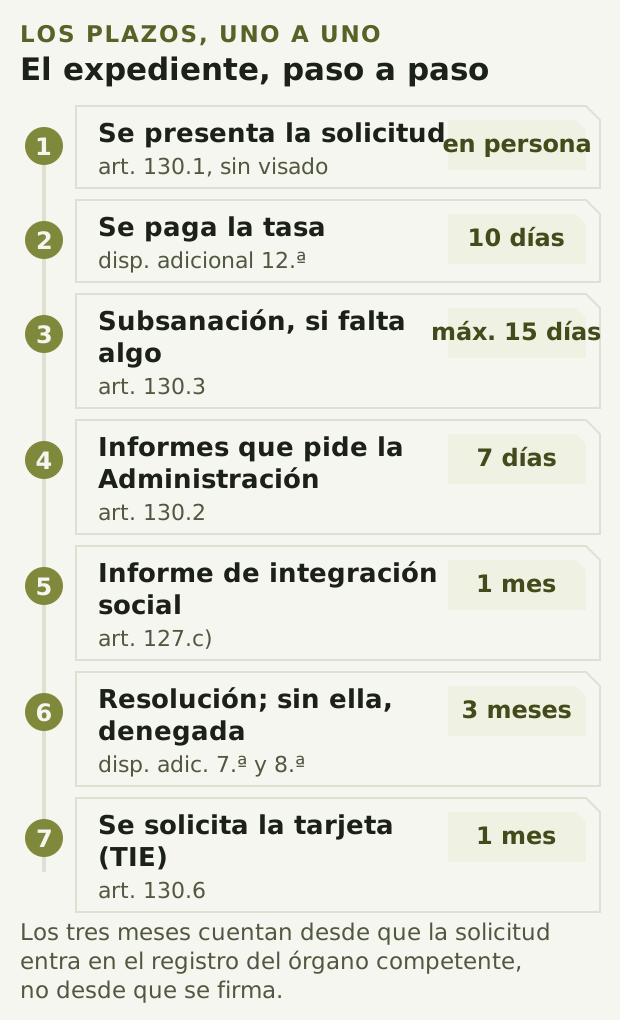
The time limits are in the Regulations and in Ley Orgánica 4/2000. The notification prevails over any summary.
-
Application in person and the fee: ten days
Article 130.1 states that it requires no visa and that it is applied for in person; representation is only possible for minors and people with a disability who need support. The fee is self-assessed, with ten days for voluntary payment.
-
If a document is missing: up to fifteen days
Article 130.3 requires a request to remedy the defect within a period that may not exceed fifteen days. If it is not remedied, the application is treated as withdrawn and the file is closed.
-
Criminal record: seven days for the checks made by the authorities
Article 130.2 requires a certificate from the countries of residence during the five years before entry, unless the person was in Spain throughout those five years. The Registro Central de Penados (the Spanish central criminal records register) certificate and the police report are obtained by the Office within seven days, and such a record does not automatically mean refusal.
-
Provisional permission (sociolaboral only)
Article 130.5 allows residence and employed work from the moment the application under article 127.b) is admitted until it is decided.
-
Decision: three months, and silence means refusal
Three months from the day after entry in the register of the competent body (seventh additional provision). The eighth refers to the first additional provision of Ley Orgánica 4/2000, which allows it to be treated as refused.
-
Social Security registration: one month
Under the sociolaboral route, article 130.5 makes the authorisation's effectiveness conditional on registration within one month of notification.
-
Applying for the foreigner's identity card: one month
Article 130.6 requires the TIE (the foreigner's identity card) to be applied for in person within the month following notification of the grant.
The documents and who issues them
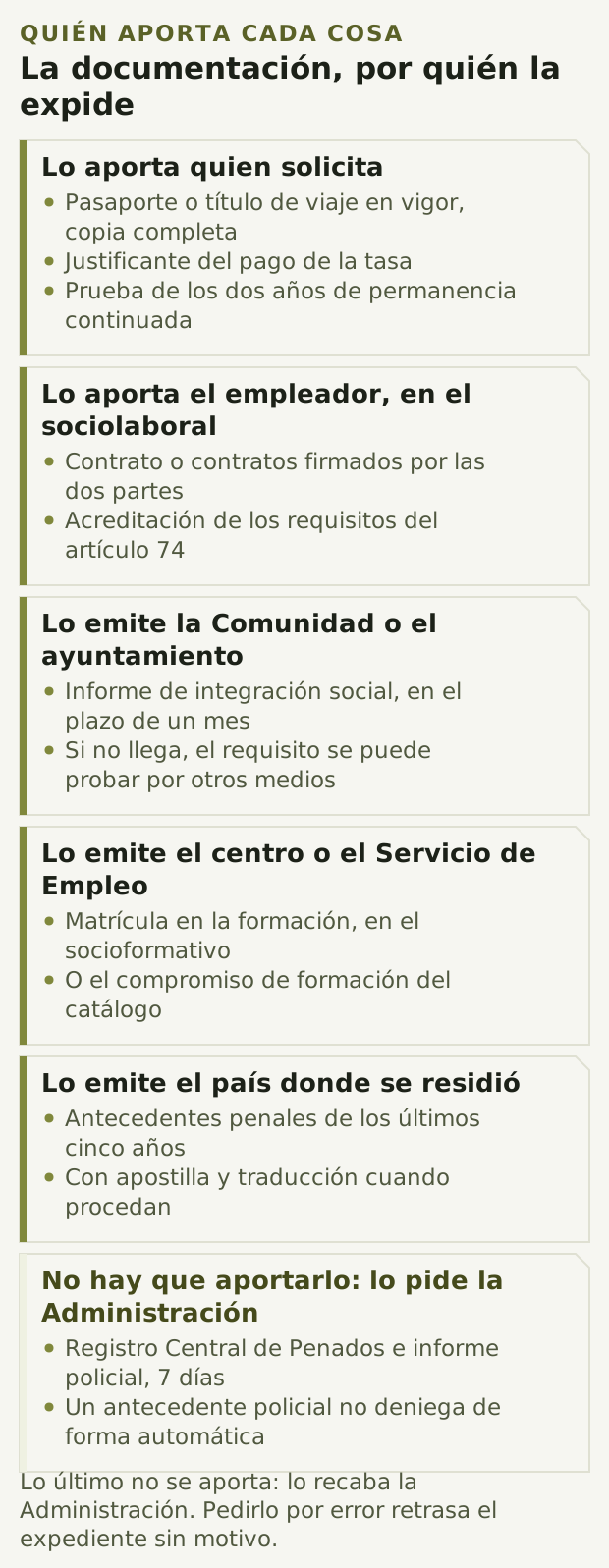
Article 130.1 lists three things: a complete copy of the passport, registration certificate or valid travel document; the contract signed by worker and employer where one is required; and the documents on the situation relied on. The third is filled in according to the route.
The two bottlenecks are outside the applicant's control. One is the social integration report under article 127.c), with a one-month time limit, which is requested from the Autonomous Community or from the council if the Community has delegated it: in several municipalities in the Barcelona area it is handled by the municipal migration department with an appointment and the padrón, something that in Badalona matters is worth knowing before starting. The other is the criminal record certificate from the country of residence, with legalisation or apostille and translation where applicable. There is a document checklist you can print out.
Working while it is processed, and afterwards
Article 131 sets the general rule: the grant carries with it authorisation to work in a self-employed or employed capacity, with no geographical or occupational limit, for as long as it is valid. It is worth saying clearly, because many people believe that arraigo only allows one specific contract. There are two exceptions: someone who has not reached the minimum age for admission to work (point a) and socioformativo arraigo, limited to thirty hours a week in employed work, paid at least the minimum wage or that of the collective agreement in proportion to the hours worked (point b).
Before the decision, the only provisional permission is the one in article 130.5, for the sociolaboral route alone: under the others, filing the application does not authorise you to work.
When the year runs out: extension or change
Article 132.1 keeps the one-year validity for these authorisations and their extensions, except for family arraigo. Article 132.2 adds conditions: for second chance, sociolaboral and social, the extension requires evidence of actively seeking work and registration with the public employment service — as worded by Real Decreto 316/2026 —, except for those who cannot take up work because of illness, disability or the legal retirement age. For the socioformativo route it is conditional on a report from the centre certifying progression to the second year, and if the course ends earlier, on evidence of the qualification plus the search for work.
The time limit is in article 132.3: the two months before expiry. Filing it then extends the validity of the previous authorisation until it is decided. An application filed within the following three months also extends it, but it opens the door to penalty proceedings for the minor infringement in article 52.b) of Ley Orgánica 4/2000: «el retraso, hasta tres meses, en la solicitud de renovación de las autorizaciones una vez hayan caducado» — a delay of up to three months in applying to renew authorisations once they have expired.
The other way out is to change the permit: article 191 governs moving from temporary residence to a residence and work authorisation without a visa.
If you are refused, or if there is no reply
The ninth additional provision of the Regulations settles the initial question: these decisions of the Government Delegates and Sub-delegates exhaust the administrative route.
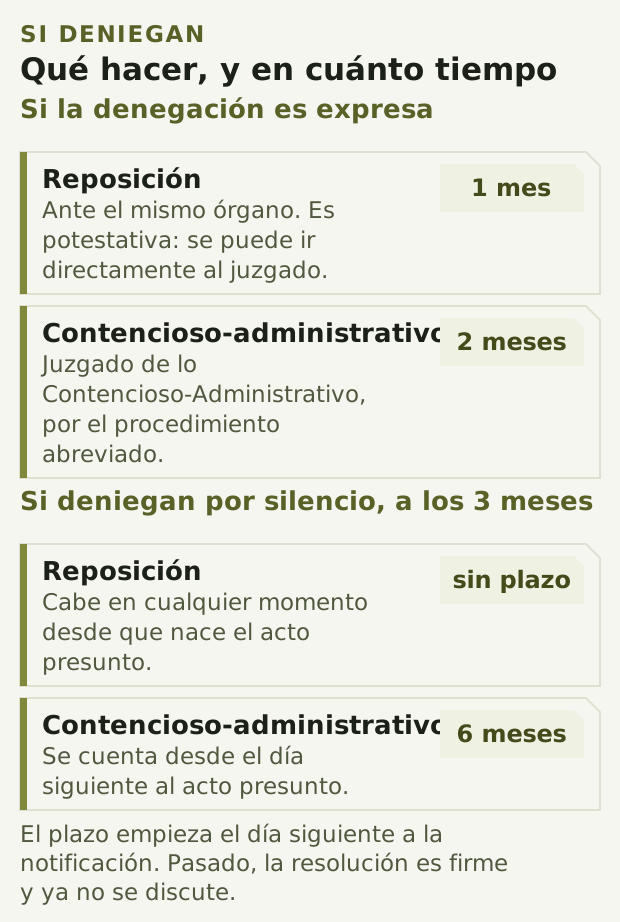
| Route | Time limit | Before whom | Rule |
|---|---|---|---|
| Remedy the defect before the file is closed | Whatever the notification sets, never more than 15 days | The body handling the file | Art. 130.3 of the Regulations |
| Optional recurso de reposición | One month from the day after notification | The same body that made the decision | Arts. 123.1 and 124.1 of Ley 39/2015 |
| Administrative court appeal | Two months from the day after notification | Juzgado de lo Contencioso-Administrativo (administrative court) | Arts. 8.4 and 46.1 of Ley 29/1998 |
| If the refusal is by silence: reposición | At any time from when the deemed decision arises | The same body | Art. 124.1, second paragraph, of Ley 39/2015 |
| If the refusal is by silence: administrative court | Six months from the day after the deemed decision | Juzgado de lo Contencioso-Administrativo (administrative court) | Art. 46.1 of Ley 29/1998 |
The reposición is optional: until it is decided or deemed dismissed, the administrative court route is not available (article 123.2 of Ley 39/2015), its time limit for a decision is one month (124.2) and the court time limit runs from then (46.4 of Ley 29/1998). It is heard by the Juzgado de lo Contencioso-Administrativo, under the shortened procedure in article 78.1. And a fresh application is not an appeal: it does not suspend time limits. The time limit checker gives an idea of the margin; the one that counts is the one in the notification, and the general mechanics are in administrative procedures in Barcelona.
Frequently asked questions about arraigo
Can the extraordinary arraigo under Real Decreto 316/2026 still be applied for?
No. Paragraph 6 of the twentieth and twenty-first additional provisions of the Regulations, added by that royal decree, states that it may be applied for until 30 June 2026. That period has expired and neither provision allows for an extension. Only the transitional regime for applications filed in time remains alive.
How many years do you have to have been in Spain to apply for arraigo?
Article 126.b) requires at least two years of continuous residence immediately before the application. Family arraigo is the exception: it requires no minimum period. If international protection was applied for, the processing time up to the final decision does not count.
My child is Spanish: am I entitled to family arraigo?
Not by that route. Article 127.e) reserves it for those who are the father, mother or guardian of a minor who is a national of another European Union State, of the European Economic Area or of Switzerland, or who provide support to a person with a disability of those nationalities. Family members of Spanish nationals go through chapter VII of title IV, article 94 onwards.
Can you work while the arraigo application is being processed?
Only under the sociolaboral route: article 130.5 allows residence and employed work from the moment the application is admitted. Under the others there is no provisional permission. Once the authorisation is granted, article 131 includes self-employed or employed work with no limit as to area or occupation, except under the socioformativo route, which is limited to thirty hours a week.
Where to consult the rule
- Real Decreto 1155/2024, Reglamento de Extranjería, consolidated text in the BOE.
- Real Decreto 316/2026, de 14 de abril, which amended it.
- Ley Orgánica 4/2000, consolidated text.
- Ley 39/2015, del Procedimiento Administrativo Común (the Spanish Common Administrative Procedure Act).
Related guides
Immigration lawyers in Barcelona
Residence and work, family reunification, nationality and appeals. Also in Arabic.
Go to the practice areaAdministrative procedures in Barcelona
Time limits, administrative silence and types of appeal against the authorities.
Read the guideLawyers in Badalona
Where the municipal arraigo reports are applied for if you are registered on the padrón there.
See the areaA guide by the firm Ajuridic. Principal: Noemí Ampurdanés Parés, ICAB lawyer no. 22359, with more than 30 years in practice. We work in Spanish, Catalan, English and Arabic (by prior appointment).
It is informative and general in nature. It does not constitute legal advice and is no substitute for a lawyer's analysis of a specific case: the rules change and the outcome depends on the facts, the dates and the documents in each file. No step taken can guarantee a result. Before filing anything or letting a time limit pass, ask about your case: Ajuridic, Carrer del Freser, 104, El Clot (Sant Martí), 08026 Barcelona · 614 26 26 92, also by WhatsApp · [email protected] · contact form.
Bring the papers in and we will see which route fits
With the dates and the documents in front of us we can say in a short time which route is available and what time limit is running. The office is at Carrer del Freser, 104, in El Clot. We work in Spanish, Catalan, English and Arabic, the last of these by prior appointment.
First visit at no charge*
*The first visit at no charge covers an initial consultation to discuss the case. It does not include prior document review. If that review is needed, or the matter concerns employment or criminal law, a fee may apply. The firm will disclose the scope and amount beforehand; the client decides whether to accept.