
Road traffic accidents in Barcelona: how to claim compensation
What to do in the hours after the accident, what documents preserve the right to claim, how the damage is valued under the baremo de tráfico (the statutory scale for road traffic injuries) and what time limits apply as against the insurer and as against the court.
After an accident: what should I do, and how long do I have to claim?
Go to A&E the same day, keep the joint report or request the police report, and claim in writing from the insurer of the party at fault before signing anything. As a general rule there is one year to claim, which with injuries runs from recovery or from when the extent of the lasting effects is known, and the insurer has three months to reply.
- 1 year
- to claim from the insurer, as a general rule. With injuries, the courts count it from recovery or from when the extent of the lasting effects is known, not from the day of the accident. A written claim to the insurer interrupts it. Art. 7.1 of the consolidated motor insurance act
- 3 months
- is what the insurer has, from receiving the claim, to make a reasoned offer or give a reasoned reply. Art. 7.2 of the same act
- Baremo
- the scale of Ley 35/2015: basic and particular personal loss are counted in days, lasting effects in points, and expenses and lost income are added separately. The amounts are updated every year. Art. 1.4 and Title IV of the act
- Copy of the police report
- free of charge for anyone who suffered loss and asks for it: the forces that police traffic (Guàrdia Urbana, Mossos d'Esquadra, Guardia Civil) must provide it. Art. 7.1 of the act
Who is answering. This guide is by Ajuridic, which handles road traffic accident claims against insurers and in court. Ajuridic is a general-practice law firm in Barcelona, based at Carrer del Freser, 104 (El Clot, Sant Martí), working in nine areas: family law and divorce, inheritance, immigration, employment, road traffic accidents, medical negligence, civil liability, fines and local government law, and property. It is led by Noemí Ampurdanés Parés, a lawyer registered with the Barcelona Bar (ICAB) under no. 22359, with more than thirty years in practice, and works with notaries, court representatives (procuradores) and expert witnesses. Service in Spanish, Catalan, English and Arabic (Arabic by appointment); support in Filipino on request.
- Road traffic accident lawyers
- What determines the compensation
- Check the time limit
- Request an appointment
Figures checked on 12 October 2026 against the sources linked. General information: it does not replace advice on your case.
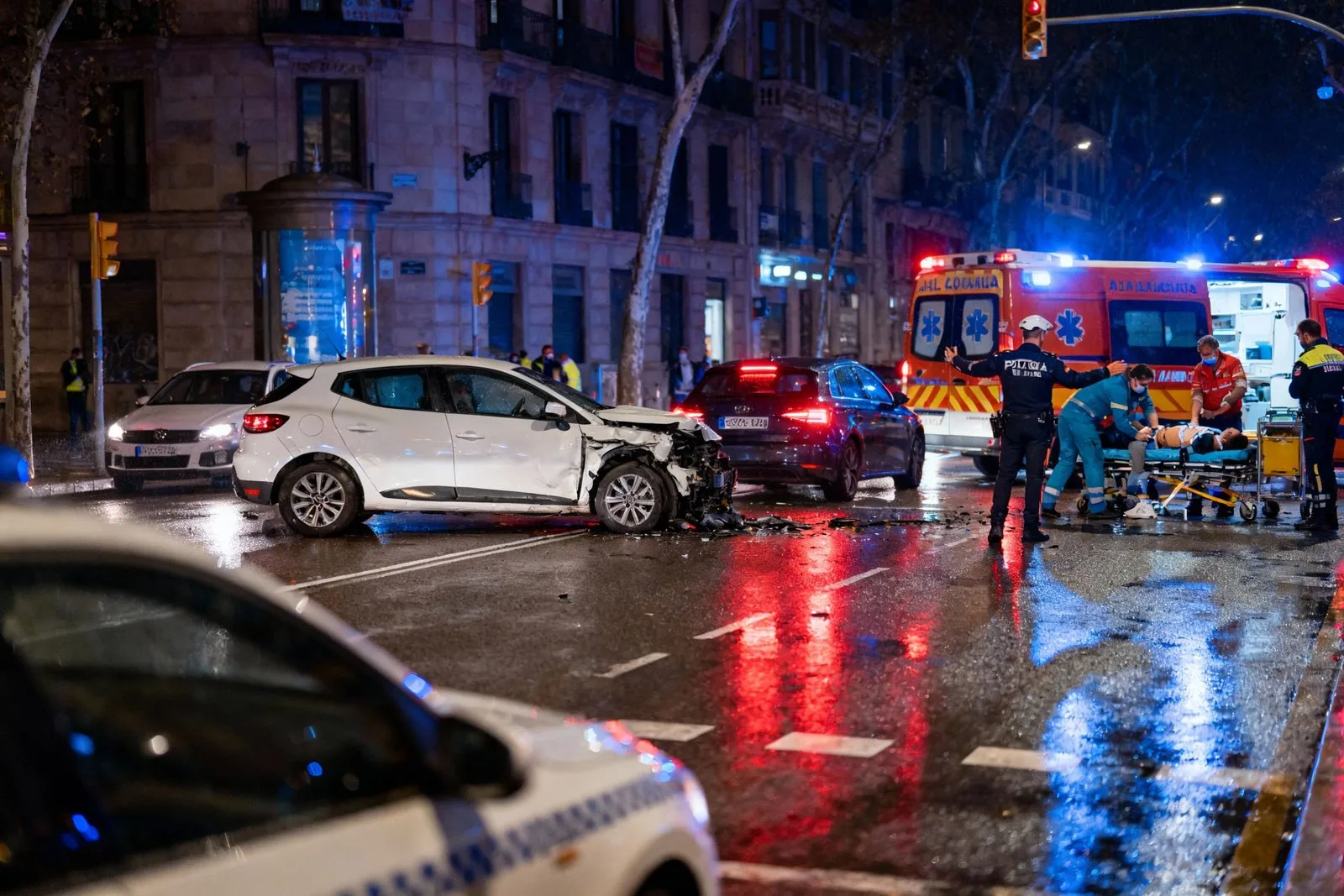
A road accident changes someone's situation in seconds, and the decisions that most affect the compensation are taken in the first few hours, when nobody is in a state to think in legal terms: whether or not to call the Guardia Urbana, whether to fill in the accident statement, whether to go to A&E even though «nothing hurts», whether to sign the first document the insurer offers.
This guide puts those decisions in order. It explains what to do at the scene, what evidence should be kept, how physical injury is valued under the statutory valuation system and what time limits must not be allowed to pass.
What to do after an accident
-
Safety and medical attention
Put out warning signs, switch on the hazard lights and wear the high-visibility waistcoat if you have to leave the vehicle. Call 112 if anyone is injured, and do not move the injured unless there is imminent danger. If there are injuries, the vehicles must not be moved until the authorities say so.
-
Attendance by the authorities
In Barcelona, the Guardia Urbana attends accidents within the municipal area, and the Mossos d'Esquadra deal with the interurban roads under their authority. Where there are injuries, disagreement about what happened, a driver who refuses to give their details or signs of alcohol or drugs, it is worth asking them to attend: the atestado (the police report on the accident) is the strongest evidence that will be available afterwards.
-
Joint accident statement
The parte amistoso (joint accident statement) signed by both drivers speeds the handling up enormously. It should be filled in calmly: sketch, direction of travel, point of impact, circumstances ticked correctly and observations. Do not sign a statement whose account you do not agree with; in that case record the disagreement or simply do not sign and take down the details.
-
Documenting the scene
Photographs of the damage to all the vehicles, of the final positions, of the road signs and of the state of the road surface. The other driver's insurance details — company and policy number — and their licence. The names and telephone numbers of witnesses: it is the thing most often forgotten and the thing most needed later.
-
Go to A&E the same day
Even if the discomfort seems minor. The A&E report dated close to the accident is what makes it possible to attribute the injuries to it. A gap of several days between the accident and the first medical attention is the argument insurers use most to dispute causation.
-
Report the incident and do not sign straight away
You must notify your own insurer within the period set by the policy. And it is best not to sign a finiquito (final settlement) or accept the first offer before knowing the final extent of the injuries: a signed finiquito closes the claim even if permanent effects appear later.
Common situations in the city and who is liable
Rear-end collision
Liability is normally attributed to the vehicle behind, for breach of the duty to keep a safe distance. It is a presumption that can be rebutted: unjustified braking, reversing, brake lights that do not work or an earlier third collision can shift it.
Pedestrian knocked down
Motor vehicle traffic is subject to a regime of strict liability for personal injury: the driver is liable unless the harm is due exclusively to the injured party's own conduct or to force majeure unconnected with the driving. Careless conduct by the pedestrian may reduce the compensation, but it rarely removes it.
Motorcycles and mopeds
The absence of bodywork turns minor impacts into significant injuries, and the usual disputes are about lane changes without checking the blind spot and doors being opened from parked vehicles. The valuation of the permanent effects is usually the financially decisive part here.
Bicycles and personal mobility vehicles
Accidents involving electric scooters raise two further questions: whether the personal mobility vehicle met the requirements of the municipal by-law — which can affect shared fault — and whether there is insurance covering the damage caused. It is set out in the guide to the Barcelona electric scooter by-law.
Uninsured, stolen or hit-and-run vehicle
There is the Consorcio de Compensación de Seguros (Spain's insurance compensation fund), which is liable where the vehicle is uninsured, unidentified or stolen, with its own rules and time limits. The fact that the person responsible drives off does not close the claim.
Defects in the road
Where the accident is due to the poor state of the road surface, defective signing or lack of maintenance, the claim is not brought against another driver but against the authority responsible for the road, for responsabilidad patrimonial (public authority liability), through the route explained in the guide to administrative procedures in Barcelona.
What damage can be claimed
- Material damage: repair or market value of the vehicle, damaged personal items, helmet, glasses, clothing, and towing and pound charges.
- Basic personal harm: the days from the accident until the injuries stabilise.
- Specific personal harm: the days of temporary loss of quality of life, graded by the degree of limitation, and the days of hospital admission or surgery.
- Permanent effects: the limitations that remain after stabilisation, both functional and aesthetic.
- Expenses: medical care, rehabilitation, prostheses, travel, and the estimate of future costs where the permanent effects require them.
- Loss of earnings: the income not received during the period off work and, where appropriate, the future financial loss where the permanent effects prevent continuing in the same occupation.
- Non-pecuniary harm to family members in cases of severe disability and death, which the law recognises for a defined list of claimants.
How the damage is valued: the baremo
Compensation for personal injury in road traffic accidents is calculated using the valuation system in Real Decreto Legislativo 8/2004, as worded by Ley 35/2015, known as the baremo de tráfico. Its amounts are updated every year, and the general criterion is to apply those in force on the date the extent of the harm is determined, that is, on medical discharge or stabilisation.
The calculation is arranged in three blocks:
- Basic and specific personal harm, by days until stabilisation.
- Permanent effects, scored under medical tables and adjusted for the injured person's age.
- Financial loss: daño emergente (the loss actually suffered) and lucro cesante (the earnings lost).
The scoring of the permanent effects is where everything is decided
Two medical reports on the same injuries can differ substantially in points, and each point has a financial translation. That is why a valuation by a doctor specialising in the assessment of physical injury, independent of the insurer, is usually decisive.
This guide does not publish specific amounts: the tables are updated annually and an out-of-date figure is misleading. The value of a case can only be estimated with the medical reports and the earnings documents in front of you.
The claim procedure
The system is designed to be resolved without litigation, and most matters end at the out-of-court stage. The route is as follows:
-
Prior claim to the insurer
It is compulsory before suing. It is addressed to the company insuring the vehicle at fault, with the documents on the accident and the injuries, and it starts the company's response periods running.
-
Offer or reasoned reply
The insurer must make a reasoned offer if it accepts liability, or a reasoned response if it rejects it, explaining why. Not replying, or replying without justification, has consequences: the special default interest under insurance contract law.
-
Contradictory medical assessment
The company calls the injured person in to see its own doctor. It is best to attend with the complete medical history and, if the proposal does not reflect the real permanent effects, to counter it with an independent expert report.
-
Settlement or court claim
If the offer is reasonable, it is closed with a finiquito. If it is not, a claim is filed before the first instance courts in Barcelona, with the expert report as the central evidence.
Time limits not to be missed
- One year to claim from the insurer, counted from the stabilisation of the injuries — not from the day of the accident — where there is physical injury. It is best not to let it pass.
- A formally recorded claim interrupts the limitation period and restarts the clock. It is best to record every claim by burofax.
- The period set by the policy for reporting the incident to your own insurer, usually very short.
- One year also for claiming against the authorities for responsabilidad patrimonial when the accident is due to the state of the road.
And one practical rule: do not sign any document from the insurer without reading it in full. A finiquito closes the claim, including the damage that was not yet known.
Frequently asked questions about road traffic accidents
How long do I have to claim after a road traffic accident?
As a general rule, one year to claim from the insurer (article 7.1 of the consolidated text of the Ley sobre responsabilidad civil y seguro en la circulación de vehículos a motor, the Spanish motor insurance act). Where there are injuries, the courts count it from recovery or from when the extent of the lasting effects is known, not from the day of the accident. A written claim to the insurer interrupts the time limit and, once the reasoned offer or reasoned reply is formally served, a new year starts to run. Other time limits may apply against the person who caused the damage, so it is best not to leave it to the last minute.
How much compensation am I entitled to after a road traffic accident?
Whatever results from applying the road traffic scale (baremo) of Ley 35/2015 to your case: the days until the injuries heal or stabilise, the points given to any lasting effects (secuelas), your expenses and the income you have lost. The amounts are updated every year, so there is no fixed figure: the estimate is made with the medical reports in front of you.
What does the insurer have to do when I claim?
Within three months of receiving the claim it must make a reasoned offer of compensation, if it accepts liability, or give a reasoned reply, if it rejects it (article 7.2 of the same act). That document is the starting point of the negotiation: it says which items it accepts and which it disputes.
Do I have to go to court to be paid?
Not always. The prior claim to the insurer is compulsory before going to court, and many cases are settled at that stage. Court comes in when the offer does not cover the proven loss or the insurer denies liability.
What if the other driver had no insurance or drove off?
The Consorcio de Compensación de Seguros pays where the vehicle is uninsured, stolen or unidentified, under its own rules. It helps to have reported the facts to the police and to keep all the evidence.
Should I sign the insurer's first offer?
Not before you are medically discharged, and not without reading it all: a signed settlement can close the claim, including any lasting effects that appear later.
Where to read the law
- Real Decreto Legislativo 8/2004, consolidated text of the Ley sobre responsabilidad civil y seguro en la circulación de vehículos a motor, with the Ley 35/2015 scale, consolidated text in the BOE.
- Consorcio de Compensación de Seguros, for uninsured, stolen or unidentified vehicles.
Other related guides
Road traffic accidents
Claiming compensation for injury and damage: medical reports, negotiation with the insurer and a court claim if necessary.
Go to the practice areaCivil liability insurance
What a policy covers, which exclusions to watch out for and how to claim when the company refuses to pay.
Read the guideMedical negligence in Barcelona
When the harm is made worse by the medical treatment that follows: how it is proved and who the claim is made against.
Read the guideGuide written by the firm Ajuridic. Principal: Noemí Ampurdanés Parés, lawyer registered with the ICAB under no. 22359, with more than 30 years in practice.
It is informative and general in nature. It does not constitute legal advice and is no substitute for the analysis of a specific case: the rules change and the outcome depends on the facts, the medical reports and the documents in each accident.
Tools for what this guide cannot calculate
The guide does not publish baremo amounts. What it does give is a detailed explanation of what determines the figure, the time limit and the list of documents.
How much am I entitled to after an accident?
What determines the compensation under the baremo: the days of loss, the score given to the permanent sequelae, loss of earnings, contributory fault and the insurer's offer.
See what the figure depends onTime limit checker
Eleven time limits covering fines, employment, damage claims and inheritance. Enter the start date and it shows the deadline for acting and how many days are left.
Check a time limitDocument checklist
The papers needed for an accident claim, tickable and printable, so you can bring them already checked to the first appointment.
Open the checklistBefore signing what the insurer offers
With the atestado or the accident statement, the medical reports and the company's offer, we can assess whether the proposal matches the real harm. The office is at Carrer del Freser, 104, in El Clot.