
E-scooters in Barcelona: obligations, riding and fines
Technical requirements for personal mobility vehicles, where they may be ridden and where they are banned, how they must be parked and what enforcement regime the Guardia Urbana applies. With the routes for appealing if the fine has already arrived.
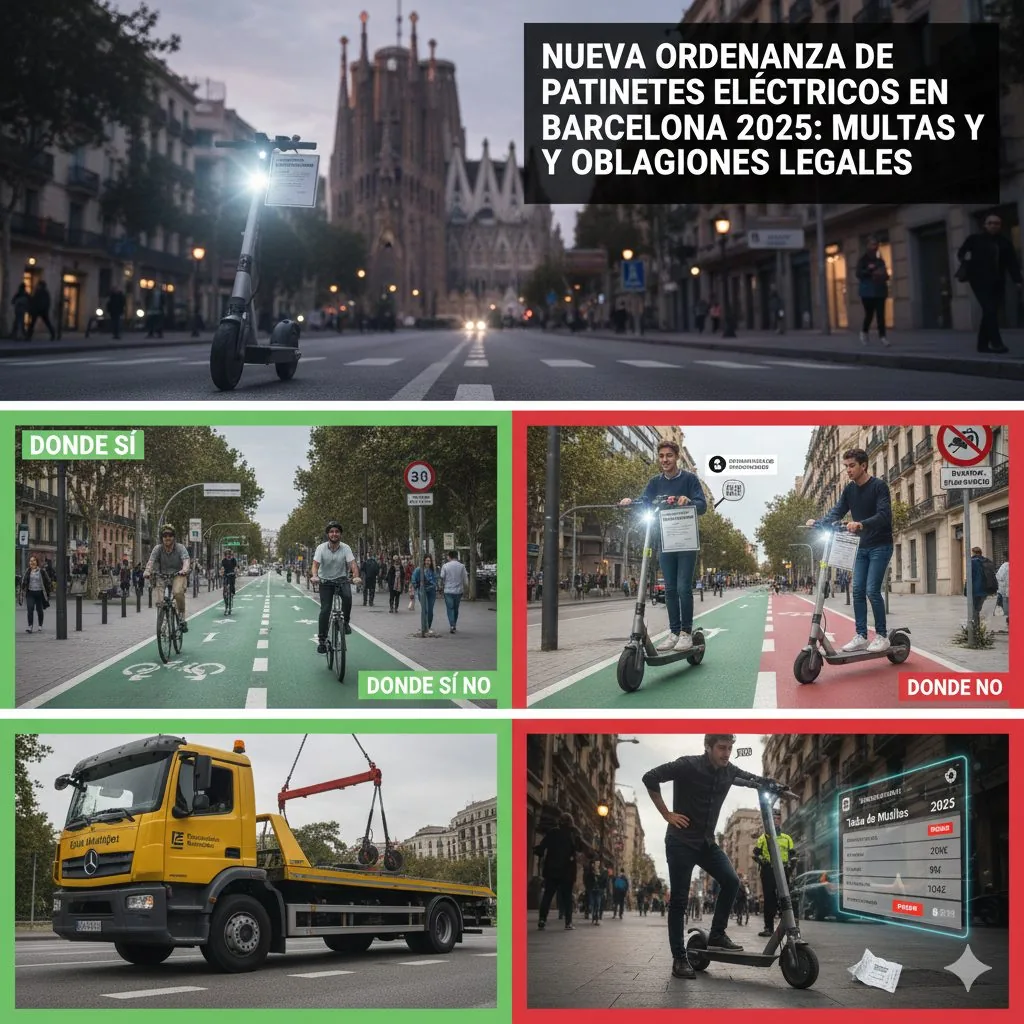
The e-scooter has established itself as a means of urban transport and, with it, a legal regime of its own that many people know nothing about until the first penalty arrives. A personal mobility vehicle is not a bicycle or a toy: it is a vehicle, its rider is subject to the traffic rules and is liable for any harm they cause.
This guide brings together what you need to know in order to ride in Barcelona without unpleasant surprises: what technical requirements the rules impose, where you can and cannot ride, how you must park, which offences the Guardia Urbana pursues and what to do when the penalty has already arrived.
The scope of this guide
It is general information only. Municipal by-laws and traffic rules change frequently; before taking a decision it is worth checking the wording in force in the official sources of Barcelona City Council and the Dirección General de Tráfico.
What is and is not a personal mobility vehicle
The Reglamento General de Vehículos (Spanish General Vehicle Regulations) defines a personal mobility vehicle as a vehicle with one or more wheels, with a single seat and propelled solely by electric motors, capable of a maximum speed of between 6 and 25 km/h.
The consequences of that definition are important:
- A machine that has been tampered with , or that leaves the factory capable of exceeding 25 km/h, is no longer a personal mobility vehicle. It is treated as a moped or a motorcycle, with everything that entails: registration plate, driving licence, approved helmet and compulsory insurance. Riding one without meeting those requirements gives rise to offences far more serious than those for a personal mobility vehicle.
- They are single-seat vehicles: carrying another person is not permitted in any circumstances.
- Machines without a motor, those intended for people with reduced mobility and toys fall outside this, with their own rules.
The Dirección General de Tráfico has published a manual of characteristics for personal mobility vehicles, which is the technical reference officers apply when they check a vehicle in the street.
Technical requirements and certificate of roadworthiness
- Certificate of roadworthiness. Personal mobility vehicles marketed after the manual of characteristics came into force must have a certificate issued by an approved laboratory showing compliance with the requirements. Those bought before then have a transitional period in which to obtain one.
- An effective braking systemacting on both wheels.
- Lighting and reflective elements: a white front light, a red rear light and reflectors, essential at night or in poor visibility.
- A bell or other audible warning device.
- A parking system allowing the vehicle to be left stable without obstructing passage.
- A maximum speed limited to 25 km/h, with no tampering with the limiter.
Tampering with the limiter is the most expensive problem
As well as the penalty and the impounding of the vehicle, a tampered scooter changes legal category. If it causes an accident, the rider may find themselves riding without a licence a vehicle with no compulsory insurance, with the civil, and in some cases criminal, consequences that entails.
Where you can and cannot ride
Where you can
- Cycle lanes, both on the carriageway and segregated. This is their natural space, respecting the posted speed and giving priority to bicycles.
- Carriageways with a limit of 30 km/h or less, riding in the centre of the lane, not close to the kerb, so as to be visible and to avoid car doors being opened.
- Reduced-speed zones and residential streets, always giving priority to pedestrians.
- Parks and signposted areas, on the terms and within the hours set by the municipal signage.
Where you cannot
- Pavements and pedestrian areas. This is the strictest prohibition and the most penalised offence in Barcelona.
- Interurban roads, motorways, dual carriageways and city tunnels, prohibited under national rules.
- The rondas (ring roads) and the city's fast through-routes.
- Bus lanes and platforms reserved for public transport.
Rules of conduct for the rider
- One person only per vehicle. Carrying a passenger is an offence in every case.
- Helmet. Compulsory for those under 16 and in the situations set by the municipal by-law. Advisable at all times: it is the only thing that genuinely reduces the seriousness of injuries.
- No mobile phone or headphones while riding, just as in any other vehicle.
- Alcohol and drugs. Riders of personal mobility vehicles are subject to the same limits as everyone else and can be required to take the relevant tests. Refusing to take them has criminal consequences.
- A minimum age for riding on the public highway, as laid down by the applicable municipal by-law.
- Compliance with signage and respect for pedestrians, including the duty to adjust speed and to give way at crossings where pedestrians have priority.
Where you can leave the scooter
Parking is the second source of disputes, because it directly affects accessibility on the pavement.
Permitted
- Parking areas provided for bicycles and motorcycles.
- Bicycle stands, where they are available and do not obstruct passage.
- Regulated parking areas on the carriageway, taking up as little space as possible, where there is no alternative.
Prohibited
- Pavements, except in expressly designated spaces and leaving the required clear width for pedestrians.
- In front of public transport stops, emergency exits, vehicle accesses and pedestrian crossings.
- Locked to lamp posts, trees, benches, traffic lights or other street furniture.
- In loading and unloading bays and in spaces reserved for people with reduced mobility.
Parking so as to obstruct passage can lead, as well as to the penalty, to the vehicle being removed by the municipal tow truck, with the removal and pound charges payable by the person responsible.
Enforcement regime
Offences are classified as minor, serious or very serious, and each classification carries a band of fine. The table below sets out the most frequent conduct by seriousness; the specific amounts are set by the rules in force and are stated in the notice.
| Conduct | Usual classification | Additional consequences |
|---|---|---|
| Riding on the pavement or in a pedestrian area | Serious | Can be aggravated if pedestrians are put at risk. |
| Riding on prohibited roads: rondas, dual carriageways, tunnels | Very serious | High risk; possible impounding. |
| Use of a mobile phone or headphones | Serious | Treated the same as in any other vehicle. |
| Riding at night without lights or reflectors | Serious | — |
| Carrying another person | Serious | The vehicle has a single seat. |
| Exceeding the maximum speed or having a tampered limiter | Serious or very serious | Impounding and possible reclassification of the vehicle. |
| Riding under the influence of alcohol or drugs | Very serious | Impounding; refusing the tests has criminal consequences. |
| Parking so as to obstruct passage | Minor | Removal by tow truck and pound charges. |
| Not having the required certificate of roadworthiness | Serious | Compulsory vehicle documentation. |
The Guardia Urbana de Barcelona may immobilise and remove the vehicle for serious and very serious offences and where the personal mobility vehicle does not meet the minimum technical requirements. The towing and pound charges are payable by the person responsible.
Insurance and liability for harm
This is the part that is least talked about and the one with the greatest consequences. Anyone who hits a pedestrian with a scooter is liable for the harm caused, and that liability does not disappear because insurance is not compulsory: without a policy, you are liable with your own assets.
- Commercial use. Businesses using personal mobility vehicles (delivery services, shared fleets) are subject to the cover required by municipal and sectoral rules.
- Private use. There are specific public liability policies for personal mobility vehicles, and some home insurance policies include family public liability cover that may extend to them. It is worth checking the policy wording expressly, because many policies exclude them.
- Minors. Parents or guardians are liable for harm caused by a minor.
Exactly what a public liability policy covers and how a claim is made is set out in the guide to public liability insurance. And if the incident involves injuries, the claim follows the route in the guide to road traffic accidents in Barcelona.
If the fine has already arrived
A charge for riding a personal mobility vehicle is dealt with like any other municipal penalty file, with the same time limits and the same opportunities for a defence. The points most argued about in practice are:
- Identification of the rider. A personal mobility vehicle has no registration plate, so identification is made on the spot by the officer. If there is an error or the charge was not served at the time, the lack of reliable identification is a strong argument.
- How the space is classified. Whether the stretch was pavement, cycle lane, single-surface street or a zone with reversed priority is not always clear on the ground, and photographic evidence of the exact spot can change the classification.
- The measurement of speed and the verification certificate for the device used.
- Defects in the file: the offence being time-barred, lapse of the proceedings, incorrect service or failure to give reasons for the amount.
The full procedure (representations, recurso de reposición and the contentious-administrative route) is explained in the guide to administrative fines in Barcelona, and the general framework of files against public authorities is in the guide to administrative procedures.
Official sources
- Barcelona City Council Mobility department, for the by-law in force and the signage.
- Dirección General de Tráfico, for the manual of characteristics for personal mobility vehicles and the national rules.
Other related guides
Fines and penalties from the City Council
How the firm handles a municipal penalty file, from the representations to the contentious-administrative route.
Go to the practice areaAdministrative fines in Barcelona
Types of penalty, grading by seriousness, paying at the reduced rate versus appealing, and the defects that quash a file.
Read the guideRoad traffic accidents in Barcelona
What to do after an accident involving injuries and how compensation is claimed from the responsible party's insurer.
Read the guideGuide written by the firm Ajuridic. Principal: Noemí Ampurdanés Parés, lawyer registered with the ICAB under no. 22359, with more than 30 years in practice.
It is general information only. It does not constitute legal advice and does not replace analysis of a specific case: municipal by-laws change and the outcome depends on the facts and the documents in each file.
If there has been an accident or a fine, this is what comes next
What determines the compensation for an accident and how long is left to make representations or appeal against a penalty.
How much am I entitled to after an accident?
What determines the compensation under the baremo: the days of loss, the score given to the permanent sequelae, loss of earnings, contributory fault and the insurer's offer.
See what the figure depends onTime limit checker
Eleven time limits covering fines, employment, damage claims and inheritance. Enter the start date and it shows the deadline for acting and how many days are left.
Check a time limitDocument checklist
The papers needed for an accident claim, tickable and printable, so you can bring them already checked to the first appointment.
Open the checklistA charge involving a scooter, or an accident with a personal mobility vehicle?
With the notice or the accident report in front of us, we can assess whether there are grounds for a defence and what cover exists. The firm is at Carrer del Freser, 104, in El Clot.