
Dismissal in Barcelona: types, time limits and what to do in the first few days
There are twenty working days to challenge a dismissal, and they are a lapse period: they run out and cannot be recovered. Before looking at anything else, that comes first. Here is the exact article of the law behind every statement.
I have been dismissed. What should I do in the first few days?
Count twenty working days from the effective date, excluding Saturdays, Sundays and public holidays, and within them file the papeleta de conciliación, which suspends the time limit. If there is no agreement, the claim goes to the employment court with the days that remain.
- Note the effective date on the letter: twenty working days run from the following day. Saturdays, Sundays and public holidays do not count; August does.
- Sign the letter only as received and do not sign the final settlement without reading it. If you have to sign, add «recibí, no conforme» (received, not agreed) next to your signature.
- Gather the letter, the contract, your last twelve payslips and your employment history report.
- File the papeleta de conciliación with the Generalitat within the time limit, or request an appointment so the firm can prepare it.
- 20 working days
- to challenge a dismissal from its effective date; the time limit lapses and cannot be revived. Art. 59.3 ET and art. 103.1 LRJS
- 15 working days
- after filing the papeleta, the time limit starts running again even if the conciliation has not taken place. Art. 65.1 LRJS
- 5 days
- is what the employer has, after a judgment finding the dismissal unfair, to choose between reinstatement and compensation. Art. 56.1 ET
- 33 days per year
- of pay if the dismissal is unfair, up to a maximum of 24 months' pay. Art. 56.1 of the Estatuto de los Trabajadores
Who is answering. In employment law, Ajuridic acts for employees in dismissals, wage claims, disciplinary sanctions and changes to working conditions. Ajuridic is a general-practice law firm in Barcelona, based at Carrer del Freser, 104 (El Clot, Sant Martí), working in nine areas: family law and divorce, inheritance, immigration, employment, road traffic accidents, medical negligence, civil liability, fines and local government law, and property. It is led by Noemí Ampurdanés Parés, a lawyer registered with the Barcelona Bar (ICAB) under no. 22359, with more than thirty years in practice, and works with notaries, court representatives (procuradores) and expert witnesses. Service in Spanish, Catalan, English and Arabic (Arabic by appointment); support in Filipino on request.
- Employment lawyers in Barcelona
- Work out the compensation
- Check the time limit
- Request an appointment
Figures checked on 12 October 2026 against the sources linked. General information: it does not replace advice on your case.

Almost everything that is lost in a dismissal is lost not because of the ruling the case deserved, but because of a deadline that expired while someone waited to see what would happen. That deadline is the backbone of this guide: how long it lasts, how it is counted and what stops it. Around it come the types of dismissal, how each is classified and what should be done in the first few days.
What follows comes from the consolidated text of the Estatuto de los Trabajadores (Real Decreto Legislativo 2/2015) and from Ley 36/2011, governing the social jurisdiction, with the article behind every statement. If you are looking for how we handle an employment matter, it is set out in employment lawyers in Barcelona, with the full table of compensation according to how the termination is classified.
There are no figures in euros here, and that is deliberate
The minimum wage, the amount of compensation and the days' pay per year of service are updated and are calculated case by case. An out-of-date figure on a law firm's website is worse than none at all. What is explained here is how the time limit works, which does not change with inflation, with a pointer to the compensation table and to the official source.
The 20-working-day time limit, and why it cannot be recovered
Article 59.3 of the Estatuto de los Trabajadores provides that a claim against a dismissal shall lapse twenty days after the day on which it took place, and that this period is counted in working days: Saturdays, Sundays and the public holidays of the place where the court sits do not count. Article 103.1 of Ley 36/2011, governing the social jurisdiction (LRJS), repeats the same rule for dismissal proceedings: twenty working days from the effective date.
The day that counts is the date of effect of the dismissal, not the date the letter was signed if they are different, and the count begins the following day. Here is the most frequently repeated error: article 183 of the Ley Orgánica del Poder Judicial (Spanish Judiciary Act) declares the whole of August to be, as a general rule, outside court business days. The dismissal lapse period is the exception: article 59.3 ET excludes only Saturdays, Sundays and public holidays from the count, without mentioning August, and that is how the courts apply it. The time limit runs during August, and anyone who waits until September to act may be too late.
Lapse, not limitation: the difference that changes everything
They are two different concepts and are frequently confused. Limitation (prescripción) is interrupted by a conclusive claim to the other party and the period starts again from zero. caducidad does not: it runs objectively, it is not interrupted by warning the employer, by negotiating verbally or by waiting for a reply, and it is stopped only by what the law expressly says stops it. Once it has run out, the claim is extinguished and there is no way of recovering it, however unjust the dismissal was.
Article 59.3 says so with a literalness that is uncommon in legislation: the lapse period is interrupted solely by the filing of the request for conciliation with the competent public body. That is the only key, and it is explained in the next section.
No step can guarantee a result
What can be said for certain is that, with the effective date in front of you, you know straight away how many working days are left. The first consultation is free of charge*, and the sooner it takes place, the more time there is to gather the documents.
The papeleta de conciliación: the only thing that stops the clock
Filing it does not restart the period from zero: it freezes it where it stood and starts it again afterwards.
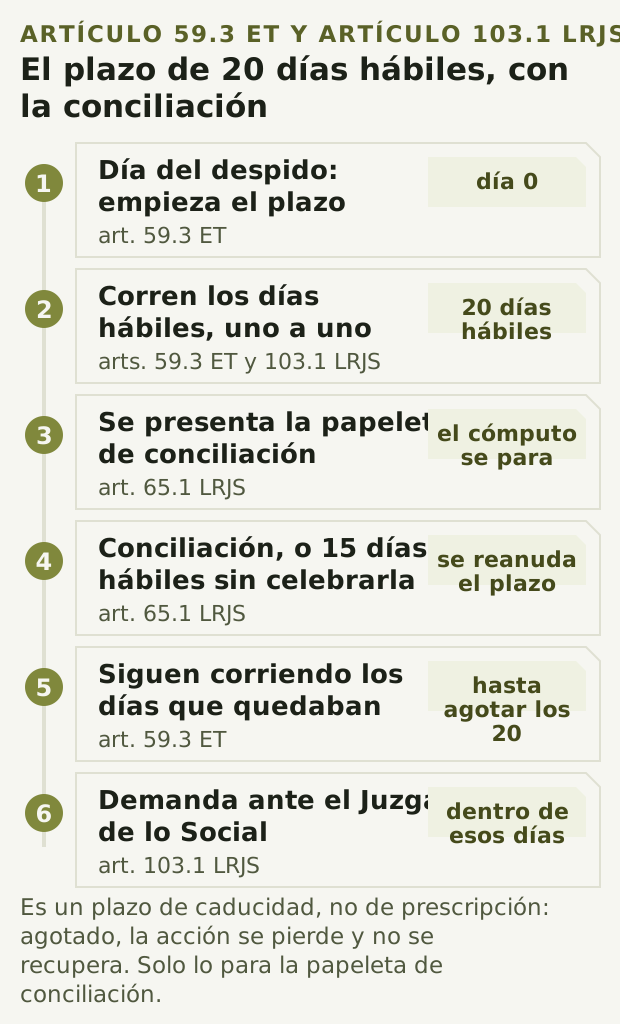
Before bringing a claim, administrative conciliation must be attempted: it is a compulsory preliminary step. In Catalonia it is filed with the CMAC (Centre de Mediació, Arbitratge i Conciliació), which comes under the Generalitat's employment department; the Barcelona office is on carrer d'Albareda. Filing is free of charge and does not require a lawyer, although it is best to have one draft it.
Article 65.1 LRJS sets out the mechanism precisely: filing suspends the lapse period from the day it is filed. The count resumes on the day after conciliation has been attempted (with or without agreement) or, if no hearing takes place, once fifteen working days have passed since it was filed. Once it resumes, only the working days that were left of the original twenty carry on running: the count does not start again.
There is a further limit in article 65 itself: if thirty working days pass without the hearing taking place or mediation being started, the step is treated as complied with and a claim may be brought. And one point worth bearing in mind: a fresh request for conciliation, or pressing the employer again in writing, is not a route the law recognises for suspending the time limit again; only the first filing has that effect.
The time limit checker of the firm gives an idea of how much time is left with a specific date in front of you, but the prudent course is not to wait until the last moment: the sooner the papeleta is filed, the sooner the time limit is frozen and the less everything depends on getting the count exactly right.
The three types of dismissal, and what changes in each
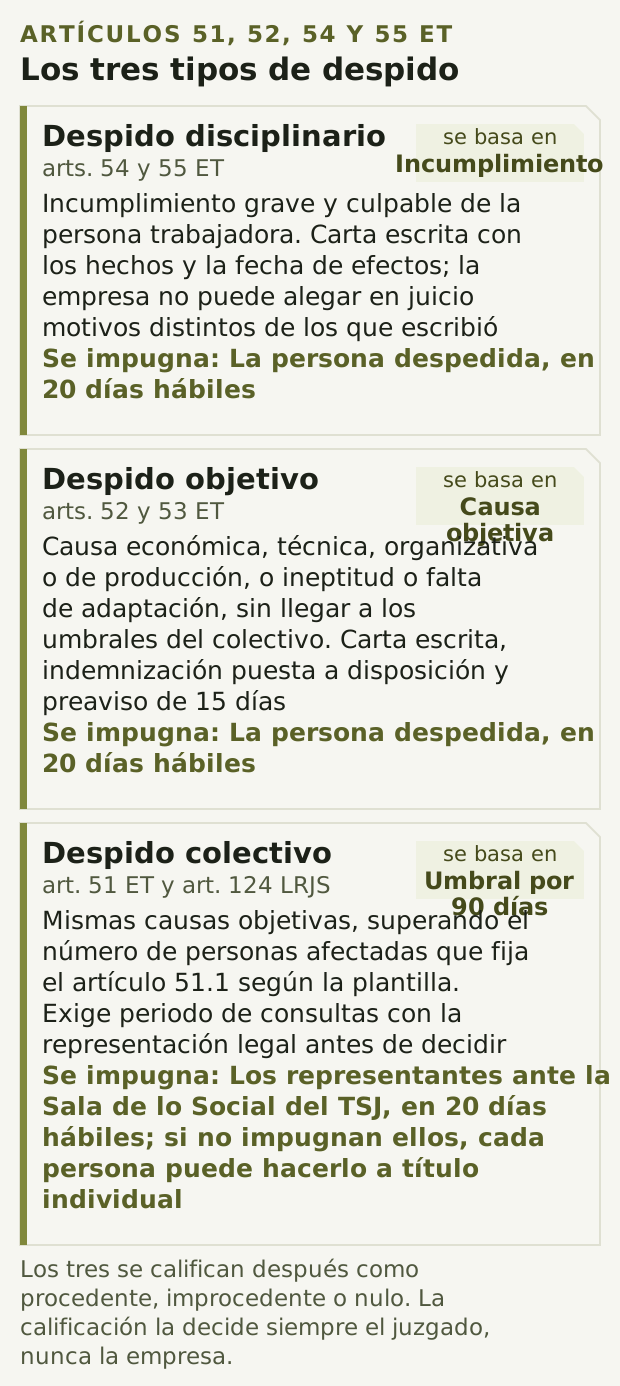
The grounds and the formalities differ, but the time limit for reacting is the same: twenty working days.
Disciplinary dismissal
Article 54 reserves this for a serious and culpable breach by the employee, and lists grounds such as repeated absence or lateness, insubordination, verbal or physical abuse, and breach of contractual good faith. Article 55.1 requires it to be notified in writing, stating the facts relied on and the date on which it will take effect. Article 105.2 LRJS adds a rule that is decisive at the hearing: the respondent will not be allowed to rely on grounds of opposition other than those already contained in that letter. An imprecise letter cannot be supplemented afterwards.
Objective dismissal
Article 52 bases this on economic, technical, organisational or production grounds, on subsequent incapacity or on failure to adapt to technical changes to the post, among other situations, where the thresholds for collective redundancy are not reached. Article 53.1 requires written notification of the grounds, compensation made available at the same time as the letter is handed over (save in justified cases of lack of liquidity, which the law also provides for) and fifteen days' notice, with the right to six hours a week off to look for work during that notice period.
Collective redundancy
Article 51.1 defines this by the number of people affected over a ninety-day period, depending on the size of the workforce, where the grounds are the same as for objective dismissal but on a larger scale. It requires a consultation period with the workforce's legal representatives, and article 51.1 itself warns that splitting terminations across successive ninety-day periods in order to get around these thresholds, without fresh grounds to justify it, is treated as a fraud on the law and renders those terminations void.
A collective redundancy is challenged differently, and again the time limit is twenty days
Article 124 LRJS reserves a collective challenge to the workforce's legal representatives, before the Employment Division of the Tribunal Superior de Justicia (High Court of Justice), also within twenty working days from the agreement or from notification to the representatives. If they do not bring one, article 124.13 LRJS opens a separate period of twenty working days for each person affected to challenge their own termination individually, counted from the end of the representatives' period.
Fair, unfair and void: what each ruling decides
The ruling is not chosen by the employer or by the dismissed employee: it is fixed by the court, in its judgment.
| Classification | When it applies | Main effect |
|---|---|---|
| Fair | The employer proves at the hearing what it alleged in the letter | Upholds the termination; no compensation and no back pay |
| Unfair | The grounds are not proved, or a formal requirement is not met | The employer chooses, within five days, between reinstatement and compensation |
| Void | It infringes a fundamental right or affects a protected situation | Reinstatement is compulsory, with payment of the wages lost |
Article 55.6 ET and article 113 LRJS agree that a finding of nullity does not allow compensation to be substituted: if the dismissal is void, reinstatement is the only outcome. Article 56.1 ET governs unfair dismissal: the employer has five days from notification of the judgment to choose between reinstating the employee and paying the compensation due; if it does not choose, it is deemed to have chosen reinstatement. The exact amount of that compensation, and its caps, are in the table on the employment law page: they are not repeated here so as not to fix a figure that changes with each person's length of service and salary.
On nullity there is a protection that surprises many people: article 55.5 ET declares it automatic in cases such as pregnancy or periods of suspension for birth or childcare, whether or not the employer knew of that circumstance, unless the dismissal is held to be fair on grounds unconnected with that circumstance or with the exercise of that leave.
What to do in the first few days, before the time limit runs out
Before signing anything
- Ask for the dismissal letter if it has not been handed over, or insist that it be put in writing with the facts and the effective date: without that there is no way of assessing the case or of counting the time limit.
- Signing the acknowledgement of receipt of the letter only shows that it has been received: it does not prevent a challenge. You can add "received, not agreed" next to the signature.
- Do not sign the finiquito with the full and final settlement wording without reading it all the way through. That clause can treat any outstanding claim as settled, including the claim over the dismissal itself.
Documents worth keeping
- The employment contract, its annexes and extensions, and the last twelve payslips.
- All communications with the employer: emails, messages, rotas and working-time records, especially anything that contradicts the grounds relied on in the letter.
- The vida laboral (employment history) report, downloadable from the Seguridad Social, and the applicable collective agreement if you know which it is.
- The certificado de empresa (employer's certificate), if it has already been provided, so that the unemployment benefit claim can be made without losing further time.
The full checklist
There is a printable document checklist with what is worth gathering for each area, and a dismissal compensation calculator which applies the Estatuto de los Trabajadores table to the length of service and salary entered.
The route, from start to finish
-
First consultation with the letter and the effective date
With those two pieces of information you know how many working days are left of the article 59.3 ET period and which ruling can be argued for.
-
Papeleta de conciliación before the CMAC
It is filed within the time limit so that it produces the suspending effect under article 65.1 LRJS. It is a compulsory preliminary step, save for limited exceptions that do not affect an ordinary dismissal.
-
Conciliation hearing
Many matters are resolved here by agreement. The firm only recommends signing if what is offered stands up against what a judgment could be expected to give.
-
Claim before the Juzgado de lo Social
Without an agreement, the claim is filed within the working days left of the original period. An employment hearing is concentrated into a single sitting: the evidence is put forward and taken that day.
-
Judgment and, where appropriate, appeal
The court classifies the dismissal as fair, unfair or void. Where appropriate, the judgment can be appealed by way of recurso de suplicación to the Tribunal Superior de Justicia de Cataluña.
Where the claim is filed: Barcelona, Badalona, Santa Coloma, Sant Adrià, L'Hospitalet and Sabadell
Article 10 LRJS lays down the general rule: the competent court is the Juzgado de lo Social for the place where the work is done, or that of the respondent employer's address, at the claimant's choice. The important qualification is that the Juzgados de lo Social have provincial jurisdiction: they do not exist in every municipality.
Anyone working in Badalona, Santa Coloma de Gramenet, L'Hospitalet de Llobregat or Sant Adrià de Besòs files their dismissal claim in Barcelona, at the Ciutat de la Justícia, Gran Via de les Corts Catalanes 111: those municipalities have no employment section of their own.
Sabadell is the exception: it has its own employment section, at Av. Francesc Macià 34-36. A dismissal in Sabadell is claimed in Sabadell, not in Barcelona.
This page is for information only and does not replace advice on a specific case. No step guarantees a result: territorial jurisdiction and the classification of the dismissal are always for the court.
Frequently asked questions about dismissal
I have been dismissed. What should I do first?
Look at the effective date on the dismissal letter and count twenty working days: that is the time limit for challenging the dismissal and, once it runs out, the claim is lost (article 59.3 of the Estatuto de los Trabajadores, the Spanish Workers' Statute). Within that period you must file the papeleta de conciliación (the request for conciliation), which suspends it. Meanwhile, do not sign the final settlement (finiquito) without reading it, and gather the letter, the contract, your latest payslips and your employment history report (vida laboral).
How long do I have to challenge a dismissal?
Twenty working days from the effective date of the dismissal, not counting Saturdays, Sundays or public holidays (article 59.3 of the Estatuto de los Trabajadores and article 103.1 of Ley 36/2011, governing the social jurisdiction). It is a lapse period: once it has run out, the claim is lost for good. Filing the papeleta de conciliación within those twenty days suspends the count.
If I file the papeleta de conciliación, is the time limit stopped for good?
No, it is stopped temporarily. Article 65.1 of Ley 36/2011 provides that the count resumes on the day after conciliation has been attempted, or once fifteen working days have passed since it was filed without a hearing having taken place. Once it resumes, whatever working days were left of the original twenty carry on running.
Do I have to sign the finiquito (final settlement) on the day of the dismissal?
There is no obligation to sign it there and then, and it is best not to do so without reading it: it usually includes a full and final settlement wording that treats any outstanding claim as closed. If it has to be signed on the spot, the prudent course is to write "recibí, no conforme" (received, not agreed) next to the signature and keep a dated copy.
Where is a dismissal claim filed if I live in Badalona, Santa Coloma, L'Hospitalet or Sant Adrià?
In Barcelona. The Juzgados de lo Social have provincial jurisdiction and do not exist in those municipalities: cases are heard at the Ciutat de la Justícia, Gran Via de les Corts Catalanes 111. The exception is Sabadell, which does have its own employment section: a dismissal in Sabadell is claimed in Sabadell.
What is the difference between a fair, an unfair and a void dismissal?
Article 55.4 of the Estatuto de los Trabajadores says so. A fair dismissal is one the employer proves in line with what it alleged in the letter: it upholds the termination with no compensation and no back pay. An unfair dismissal is one that is not proved or that fails on formalities: the employer chooses, within five days, between reinstatement and compensation. A void dismissal is one that infringes a fundamental right or affects a specially protected situation: reinstatement is compulsory, with payment of the wages lost. The classification is always decided by the court, never by the employer.
How much severance pay am I entitled to?
If the dismissal is declared unfair (improcedente), 33 days' pay per year of service, up to a maximum of 24 months' pay; if the contract started before 12 February 2012, the time before that date is calculated at 45 days per year and a different cap applies: 720 days' pay, or more if that period already exceeds it, but never more than 42 months' pay (eleventh transitional provision). For an objective dismissal, 20 days per year, up to a maximum of 12 months' pay. The exact amount depends on the salary used for the calculation and on length of service: the dismissal compensation calculator gives a rough estimate.
Where to consult the rule
- Real Decreto Legislativo 2/2015, Estatuto de los Trabajadores, consolidated text in the BOE.
- Ley 36/2011, reguladora de la jurisdicción social, consolidated text.
- Administrative employment conciliation, a procedure of the Departament d'Empresa i Treball of the Generalitat de Catalunya.
Related guides
Employment lawyers in Barcelona
Dismissals, claims for unpaid sums, disciplinary penalties and the full table of compensation.
Go to the practice areaLawyers in Sabadell
The exception to the rule: Sabadell has its own employment section.
See the areaAdministrative procedures in Barcelona
Other lapse and limitation periods, and how to appeal against a decision of the authorities.
Read the guideA guide by the firm Ajuridic. Principal: Noemí Ampurdanés Parés, ICAB lawyer no. 22359, with more than 30 years in practice. We work in Spanish, Catalan, English and Arabic (by prior appointment).
It is informative and general in nature. It does not constitute legal advice and is no substitute for a lawyer's analysis of a specific case: the rules change and the outcome depends on the facts, the dates and the documents in each file. No step taken can guarantee a result. Before letting a deadline pass, get advice on your case: Ajuridic, Carrer del Freser, 104, El Clot (Sant Martí), 08026 Barcelona · 614 26 26 92, also by WhatsApp · [email protected] · contact form.
Bring the letter and the date, and you will know the time limit straight away
With the dismissal letter and the effective date in front of us, we can work out on the spot how many working days are left and which ruling can be argued for. The firm is at Carrer del Freser, 104, in El Clot. We deal with clients in Spanish, Catalan, English and Arabic, the last of these by appointment.
First visit at no charge*
*The first visit at no charge covers an initial consultation to discuss the case. It does not include prior document review. If that review is needed, or the matter concerns employment or criminal law, a fee may apply. The firm will disclose the scope and amount beforehand; the client decides whether to accept.