
Administrative fines in Barcelona: a guide to responding to a penalty
A notice has arrived from Barcelona City Council, from the Generalitat or from the Dirección General de Tráfico. Before paying, it is worth knowing what kind of penalty it is, what time limit is running, what is given up by paying at the discounted rate and which defects in the file allow it to be quashed.
I have received a fine in Barcelona: should I pay or appeal?
It depends on what lies behind the amount. For traffic fines, paying within 20 calendar days with the 50% reduction closes the file, but you give up representations and it does not prevent the loss of points. Appealing is worth it when points or additional measures are at stake, when the facts did not happen as described or when the file has defects, such as time-barring or defective service.
- 20 calendar days
- for traffic fines, from service of the fine, to pay at the reduced rate or to submit representations and propose evidence. Art. 93.1 of the Ley de Tráfico (Spanish Traffic Act)
- 50%
- off if paid within that period; in exchange you give up making representations, the procedure ends and only an appeal to the administrative courts remains. It does not apply to excluded offences, such as failing to identify the driver or carrying a radar jammer. Arts. 93.2 and 94 of the Ley de Tráfico
- 3 and 6 months
- is when minor (3) and serious or very serious (6) traffic offences become time-barred, counted from the day of the facts; service of the fine interrupts the period. Art. 112.1 and 2 of the Ley de Tráfico
- 1 month
- for an optional appeal for reconsideration (recurso de reposición) against the penalty decision, from the day after it is served. Art. 96.2 of the Ley de Tráfico; generally, art. 124 of Ley 39/2015
Who is answering. This guide is by Ajuridic, which handles penalty proceedings brought by Barcelona City Council, the Servei Català de Trànsit and the DGT. Ajuridic is a general-practice law firm in Barcelona, based at Carrer del Freser, 104 (El Clot, Sant Martí), working in nine areas: family law and divorce, inheritance, immigration, employment, road traffic accidents, medical negligence, civil liability, fines and local government law, and property. It is led by Noemí Ampurdanés Parés, a lawyer registered with the Barcelona Bar (ICAB) under no. 22359, with more than thirty years in practice, and works with notaries, court representatives (procuradores) and expert witnesses. Service in Spanish, Catalan, English and Arabic (Arabic by appointment); support in Filipino on request.
- Lawyers for fines in Barcelona
- What to do with your fine, step by step
- Check the time limit
- Request an appointment
Figures checked on 12 October 2026 against the sources linked. General information: it does not replace advice on your case.
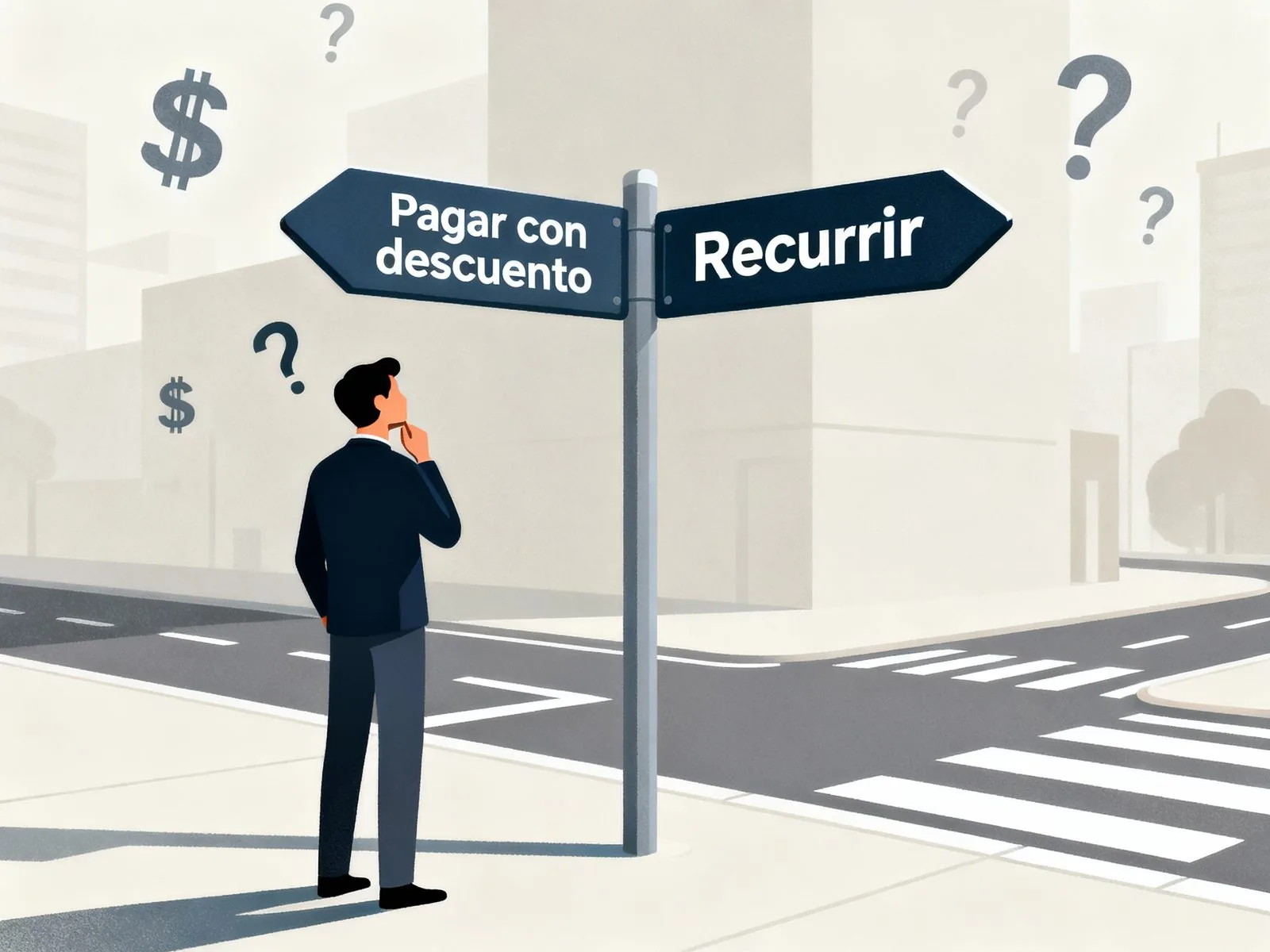
Receiving an administrative penalty produces two equally frequent reactions, and both are bad: paying at once to be rid of it, or leaving the envelope in a drawer. The first closes the file and gives up the right to argue about it; the second lets the time limits run until the penalty becomes final and passes to enforced collection. Between the two there is a window for deciding that lasts a few weeks, and that is what this guide tries to explain.
At Ajuridic we handle penalty files from Barcelona City Council and from the regional and national authorities, from El Clot, in Sant Martí. What follows is the general course of a file: what types of fine exist, how they are graded, what paying at the reduced rate involves, how to appeal and which procedural defects end up quashing the penalty.
A fine is not a final judgment
Until the time limits have run out, the penalty is a proposal by the authorities that can be argued about. The right to make representations, to put forward evidence and to appeal is part of the procedure; it is not a favour.
What an administrative fine is and who imposes it
An administrative fine is a financial penalty imposed by a public authority for breach of a rule. Unlike a criminal penalty, it does not carry imprisonment or a criminal record, but it does have immediate financial consequences and, in some cases, serious ancillary ones: loss of driving licence points, immobilisation or removal of a vehicle, closure of a business or loss of a licence.
The procedure by which they are imposed is governed, generally, by Ley 39/2015, on the Common Administrative Procedure of Public Authorities, and the principles governing the power to impose penalties are in Ley 40/2015. On that common framework, each subject area adds its own sectoral rules: the road traffic and safety act, municipal by-laws, the rules on waste, on business activities or on employment.
In Barcelona, the authorities that open the most penalty files are:
- Barcelona City Council, through its by-laws: traffic, community relations, public behaviour, waste, terraces, business activities and housing.
- The Generalitat de Catalunya, in tax, consumer, environmental and animal welfare matters, among others.
- The Dirección General de Tráfico and the Servei Català de Trànsit, on road safety outside the strictly municipal sphere.
- The Inspección de Trabajo y Seguridad Social (labour and social security inspectorate), on registrations, social security contributions and health and safety at work.
Knowing which of them issued the decision is not a formality: it determines who representations are made to, which appeal comes next and which court will review the matter if it has to go that far. That whole circuit is explained in the guide to administrative procedures in Barcelona.
The most common types of penalty in Barcelona
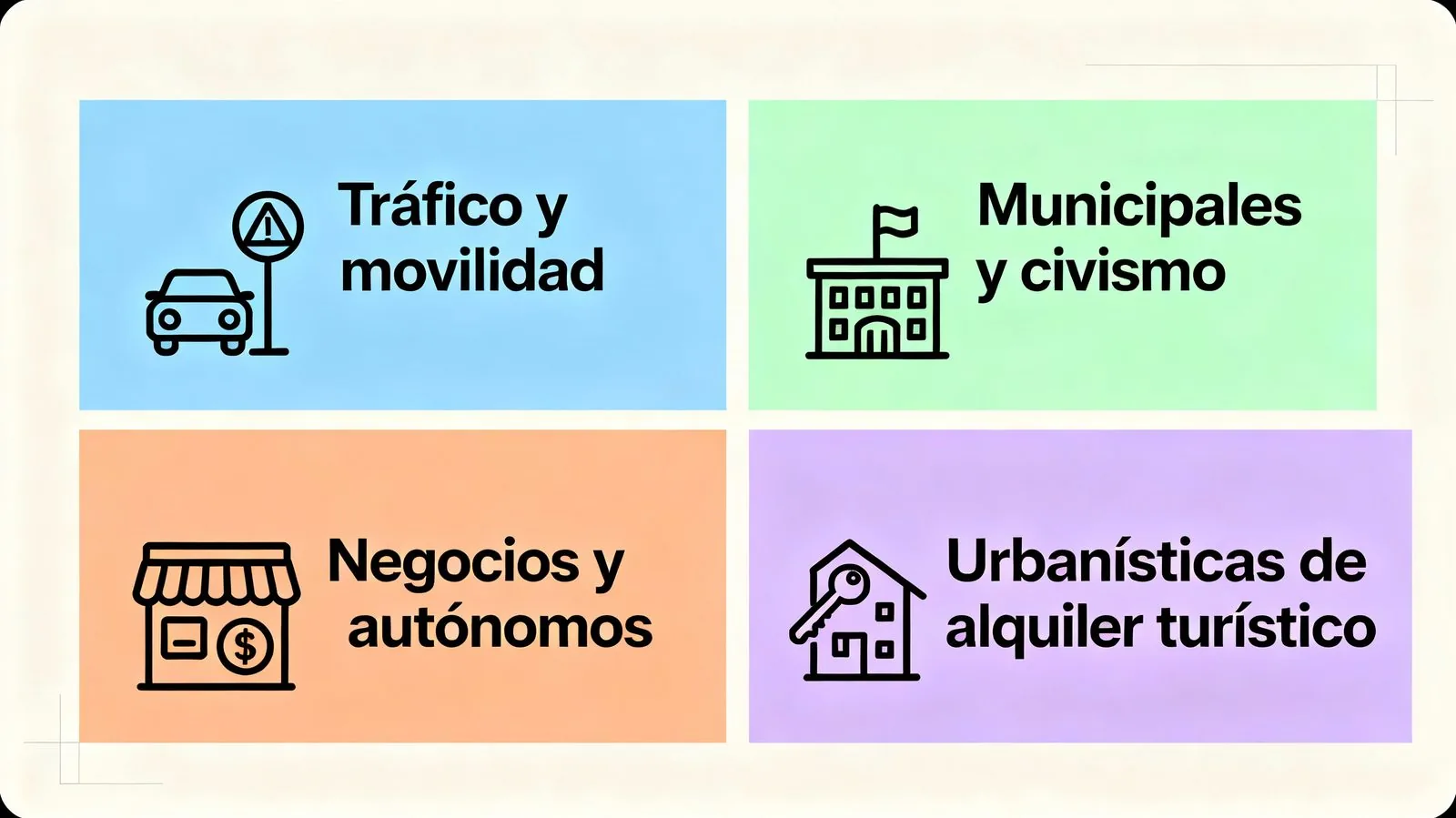
Traffic and mobility
These are the most numerous, and in Barcelona they are not limited to speeding. The Zona de Baixes Emissions (Low Emission Zone) generates a high volume of penalties for driving without an environmental badge within the restricted area and hours. To these are added those captured by red-light and bus-lane cameras, parking penalties, and those affecting personal mobility vehicles: riding on the pavement, wearing headphones or carrying a passenger on an e-scooter. The full regime for personal mobility vehicles is set out in the guide to the Barcelona electric scooter by-law.
Community relations and public behaviour
These come from the Ordenança de mesures per a fomentar i garantir la convivència ciutadana a l'espai públic de Barcelona (Barcelona by-law on community relations in public spaces) and from the environmental and waste by-laws. They cover noise in homes and premises, drinking alcohol in the street, graffiti, improper occupation of public space and incorrect waste management, including putting rubbish out outside the set hours or faulty separation of waste in commercial premises.
Business activities and the self-employed
Where the person under investigation is a company or a professional, the amount rises and ancillary measures appear that can bring the business to a halt. The usual situations are carrying on an activity without the required licence or prior notification, breaching the conditions of the licence granted (the typical case being terraces with more tables or more space than authorised), tax penalties and those arising from a labour inspection.
Housing and planning
Barcelona City Council carries out intensive inspection work on the tourist use of homes without the corresponding authorisation, on works without a licence and on breaches of the duty to maintain buildings. These are the files with the highest amounts and the ones most often carrying orders to stop or to reinstate. Where the file concerns a property that is also being bought or sold, it is worth also reading the guide to buying and selling property in Barcelona, because a planning breach that is not time-barred passes with the property.
How they are graded: minor, serious and very serious
Every penalty rule classifies breaches as minor, serious and very serious, and attaches a band of fine to each category. The classification is not decorative: the amount, the limitation period for the breach and the possibility of imposing ancillary penalties all depend on it. Within the band, the authority must give reasons for the specific amount, taking account of intent, repetition, the harm caused and the benefit obtained; where it gives no reasons, there is an argument for the defence.
| Classification | Usual band | Common examples |
|---|---|---|
| Minor | Up to about €750 | Improper parking, putting waste out outside the set hours, formal breaches. |
| Serious | Between about €751 and €1,500 | Going through a red light, significant speeding, night-time noise. |
| Very serious | From about €1,501, with no common ceiling | Dangerous driving, environmental breaches, illegal tourist use of a home. |
The bands are indicative
Each set of sectoral rules sets its own amounts and some depart a long way from this scale: in housing and environmental matters the maximums are far higher. The amount that governs is always the one stated in the notice, with the provision that supports it.
Paying at the reduced rate or appealing
Almost every notice offers a lower amount for paying early. In traffic matters, payment within the voluntary period halves the amount. In the common administrative procedure, Ley 39/2015 provides for cumulative reductions for admitting responsibility and for paying voluntarily before the decision. The discount is real, but it has a legal price that the notice does not always explain clearly.
- If you pay: the proceedings end, responsibility is treated as admitted and the right to argue about the facts is given up. Only the contentious-administrative route remains open, on very limited grounds, and in practice it is all but closed.
- If you appeal: the reduction is lost, but the possibility opens up of the penalty being quashed altogether, reduced, or of the file lapsing.
There is no single answer. It is usually worth arguing about the file in these situations:
- The amount is high and the reduction does not make up for the harm.
- The penalty carries a loss of licence points and the licence is a tool of the trade.
- There are visible formal defects: wrong registration number, wrong identification of the registered keeper, wrong address for service, no certificate of verification for the speed camera or the sound level meter.
- The events did not happen as described and there is evidence of that.
- The penalty carries ancillary measures (closure, cessation of business, withdrawal of a licence) whose effect far exceeds the amount.
By contrast, where the penalty is minor, carries no ancillary measures and the facts are undeniable, the sensible decision is usually to pay at the reduced rate. Part of the firm's work consists precisely in saying when there are no prospects.
How an appeal works, step by step
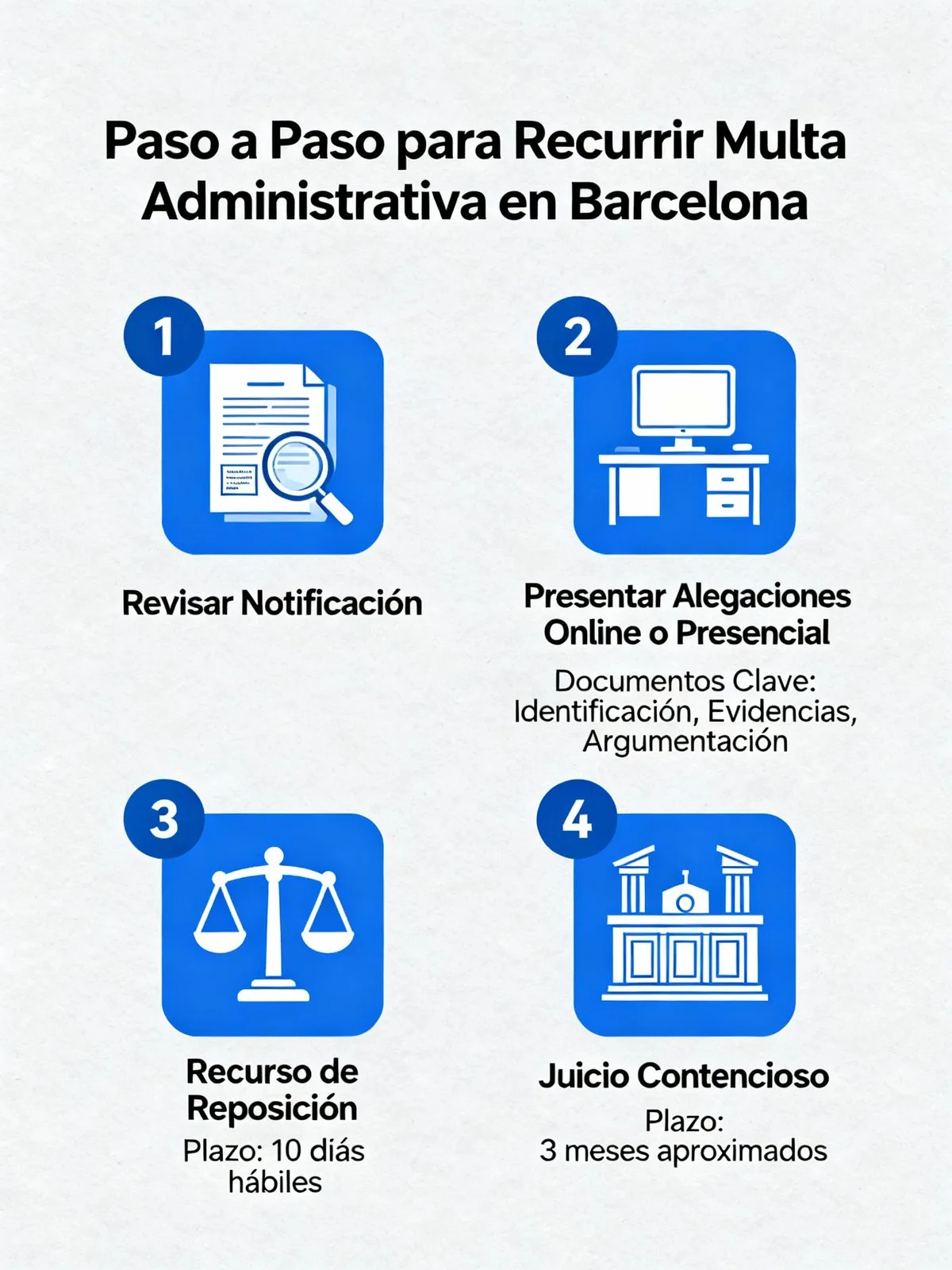
-
Read the whole notice
The notice contains the information that governs everything else: the date and place of the events, identification of the person alleged to be responsible, the provision breached, the classification, the amount, the investigating body, the body competent to decide and, at the end, the appeal notice, which states which appeal is available, to whom and within what time. It is worth keeping the envelope or the electronic receipt too: the date of service is the starting point for the count.
-
File representations within the proceedings
This is the first defence document and it is filed within the time limit stated in the notice itself. In it, the facts are denied or qualified, documents are provided and evidence is put forward: the photograph from the camera, the periodic verification certificate for the measuring device, the report of the officer bringing the charge, the calibration sheet for the sound level meter. A generic document downloaded from the internet is usually dismissed out of hand; what sustains a submission is the specific fact and the specific rule.
-
Follow the investigation and the proposed decision
The authority must rule on the evidence put forward and, if it rejects it, give reasons. Refusing relevant evidence without reasons causes prejudice to the defence and is a ground of nullity that is relied on later. At this stage there is a hearing before the decision is taken.
-
Lodge the administrative appeal
Against the penalty decision there is a recurso de reposición to the same body, or a recurso de alzada to the superior body, depending on who decided and on whether the act exhausts the administrative route. The general time limit is one month from the day after service. This is where procedural defects and lack of reasons are argued, as well as the substance.
-
Go to the contentious-administrative route
Once the administrative route is exhausted, what remains is an appeal to the Juzgados de lo Contencioso-Administrativo in Barcelona, within two months of service of the decision that exhausts that route. This is the stage at which an impartial third party reviews what the authority has done, and with large penalties or ones carrying ancillary measures it is often the only real means of defence.
Throughout, an application can be made for suspension of enforcement of the penalty. It is not granted automatically: it has to be shown that enforcement would cause harm that is impossible or difficult to put right, and the amount often has to be secured.
Defects in the file that quash a penalty
A good proportion of the penalties that fall away do so not because the substance is disputed but because the authority has not followed its own procedure. These are the grounds that succeed most often:
- The breach is time-barred. Each set of rules fixes the period (in traffic matters, three months for minor breaches and six for serious and very serious ones) and it is counted from when the act was committed. If valid service arrives after that, the breach can no longer be penalised.
- The proceedings have lapsed. Penalty proceedings have a maximum period within which they must be decided and notified. Once it is exceeded, they lapse, and even if the breach is not time-barred, what has been done does not interrupt the limitation period.
- Defects in service. The authority must attempt service at the address twice, at different times of day, before resorting to publication in the Tablón Edictal Único of the BOE. Publishing without having exhausted those attempts is a ground of nullity.
- Absence or insufficiency of evidence. An officer's report enjoys a presumption of truth as to the facts they personally observe, but it is a presumption that can be rebutted and it does not cover value judgments or data obtained from devices without current verification.
- Failure to give reasons for the amount. Imposing the maximum amount in the band without explaining why is a decision that can be reviewed.
- Errors in identification. Wrong registration number, confusion between registered keeper and driver, or a defective request to identify the driver.
None of these grounds is reliably taken into account of the authority's own motion: they have to be raised, proved and put forward at the right procedural moment.
Where to check the official information
- Barcelona City Council electronic office, to consult and deal with municipal files.
- Ley 39/2015, del Procedimiento Administrativo Común (the Spanish Common Administrative Procedure Act), consolidated text in the BOE.
- Dirección General de Tráfico electronic office, for traffic penalties and the edictal notice board.
Frequently asked questions about administrative fines
How long do I have to challenge a traffic fine in Barcelona?
From service of the fine there are 20 calendar days to make representations and submit or propose evidence, or to pay with the 50% reduction (articles 93 to 95 of the Ley de Tráfico; the reduction does not apply to excluded offences, such as failing to identify the driver). The penalty decision can be challenged by an optional appeal for reconsideration within one month from the day after it is served (article 96); you can also go straight to the administrative courts, within two months of that service, and if you lodge the appeal for reconsideration those two months run from when it is decided or deemed rejected (article 46 of the Ley de la Jurisdicción Contencioso-administrativa). The notice states the authority and the appeal that apply.
How do I check whether there are outstanding fines in Barcelona?
On Barcelona City Council's electronic office with a digital certificate, Cl@ve or idCAT, and on the Dirección General de Tráfico's site for traffic penalties. Where personal service has not been possible, the penalty is published in the Tablón Edictal Único of the BOE, which can also be searched by DNI number.
What happens if I neither pay nor appeal?
The penalty becomes final and moves to the enforcement stage. The enforcement surcharge and late-payment interest are added, and the authorities can attach bank accounts, wages (within the statutory protected limits) or tax refunds. Once that point is reached, the scope for argument is reduced to the grounds for opposing enforcement, which are very limited.
Is it worth appealing a small fine?
It depends on what lies behind the amount. If it carries no loss of licence points or ancillary measures and the facts are correct, paying at the reduced rate is usually the sensible option. If the penalty counts as a previous offence for future repeat offences, affects a licence or is based on facts that did not happen, the amount is no longer the test.
When does the time limit for appealing start?
From the day after valid service of the notice, not from the date of the offence or from the day the envelope is opened. That is why it is worth keeping the delivery receipt or the electronic acknowledgement: if the date of service has been counted wrongly, an appeal filed in time may have been wrongly rejected as out of time.
Can I pay with the 50% discount and also make representations?
No. Paying at the reduced rate means giving up representations, which are treated as not submitted; the procedure ends on the day of payment and only an appeal to the administrative courts remains, with the time limit running from the day after payment (article 94 of the Ley de Tráfico). The discount does not remove any loss of licence points.
Other related guides
Fines and penalties from the City Council
How the firm handles a municipal penalty file: reviewing the notice, representations, appeals and the contentious-administrative route.
Go to the practice areaAdministrative procedures in Barcelona
Time limits, administrative silence and types of appeal against any decision of a public authority, not just penalty decisions.
Read the guideE-scooters and personal mobility vehicles in Barcelona
Technical requirements, where they may be ridden and parked, and the table of offences under the municipal by-law.
Read the guideGuide written by the firm Ajuridic. Principal: Noemí Ampurdanés Parés, lawyer registered with the ICAB under no. 22359, with more than 30 years in practice.
It is general information only. It does not constitute legal advice and does not replace analysis of a specific case: the rules change and the outcome depends on the facts, the dates and the documents in each file.
Check the time limit before deciding whether to appeal
The period for representations and the periods for appeals expire without warning. Free tools that work in your browser.
Time limit checker
Eleven time limits covering fines, employment, damage claims and inheritance. Enter the start date and it shows the deadline for acting and how many days are left.
Check a time limitDocument checklist
The list of papers for six of the firm's procedures, tickable and printable, so you arrive at the first consultation with the file already checked.
Open the checklistBring the notice in and we will look at it
With the file in front of us, we can say in a short time whether there are grounds for appealing, how much time is left and what documents are worth gathering. The firm is at Carrer del Freser, 104, in El Clot, close to Camp de l'Arpa, La Sagrera and Navas.